Showing posts with label Literature. Show all posts

Monday, April 23, 2012

Links to the Present - 4/24/12

We here at the Infusion are taking Tuesdays to share a little of what's caught our fancy over the preceding week. We call it "Links to the Present." Peruse our offerings and give the article titles a click.


A Point of View: In Defense of Obscure Words - BBC columnist Will Self derides the paucity of personages amenable to engaging with obstreperous parlance (the lack of people willing to read works that use difficult words).

Insane 'Tube Transport' Will Zip You From New York to L.A. in 45 Minutes - This brief animation lays out the general schematic for an energy-efficient travel system that could probably make your commute shorter than the time it takes for you to key your car's ignition.

Tolstoy or Dostoevsky: Eight Experts on Who's Greater - Tired of seeing endlessly reductive internet polls and rankings that unfairly simplify legitimately complex debates? Me neither! Seriously though, some heavy duty Russian scholars tackle the age old question while simultaneously giving me a hankering for Borscht and The Brothers Karamazov.

Five Things Alfred Hitchcock's Films Taught Me - On the lighter side, the British Film Institute's Heather Stewart (no relation to Jimmy, presumably) noted recently that Hitchcock might deserve to be on Britain's national curriculum alongside Shakespeare. Ann Billson contemplates what the Master of Suspense can teach us.

This is just horrible.  In another sector of "British film," this couple pays 750 pounds for what some are calling the worst wedding photos ever. As you will see they are...shockingly bad. According to this source for the same story, part of the reason for the blurry photos was a self-proclaimed "epileptic photographer" who couldn't safely use a flash. There is nothing funny about epilepsy, but maybe, just maybe, that guy is in the wrong business.

Swan Songs

By Josh Corman

What If?

What if John Lennon had been shot in 1969 rather than 1980? What if, just weeks before the release of Abbey Road, the most significant member of the most significant musical group in history had left this world? And what if, instead of leaving behind a fully recorded, mixed, and mastered piece of visionary art, John had struggled to finish some of his compositions. What if only half the vocals had been laid down, or what if he had never quite been satisfied with the guitar on "Come Together?" What would the rest of the group have done? What would the release day for Abbey Road have looked like if fans knew, beyond any doubt, that the last glimpse into John Lennon's genius, moving full steam ahead, would come on October 1st, 1969, and that it really didn't look like what he would have wanted out there?

What a shame it would have been, obviously. It's sad enough when a towering creative figure dies at the end of a long, productive life and career, or even when they die young, but with their best creative days likely behind them. But when a Kurt Cobain or James Dean goes, right at what should be the apex of what they've striven to give the world? We listen to that last record or watch that last film, and we search for something, some flicker of the promise we know we've lost, and it comforts and pains us all at the same time.

The Pedestal


The most fascinating novel ever written about taxes and accounting.
For a number of reasons, I looked forward with near unhinged madness to this year's Spring Break. Besides all the usual perks of a work-free week, I had been saving something very important: David Foster Wallace's final novel, The Pale King. The combination of wild anticipation and anxiousness with which I had looked forward to reading Wallace's final work (he committed suicide in 2008 after a long, troubled battle with depression and addiction) was something that I hadn't experienced since reading the final Harry Potter novel in 2007. In that case, I was only anxious because I wanted so badly to love the story and discover the answers to questions I'd been asking for years. The Pale King brought with it a different layer of emotion. This was the last time I would read a novel by one of my three favorite writers of all time, and knowing you're losing a character doesn't feel nearly as bad as losing an author. I had devoured Wallace's previous two novels, The Broom of the System and Infinite Jest, near the beginning of last year and read one of his two nonfiction collections, Consider the Lobster, the previous Christmas. In the time between reading those works and opening The Pale King, I had watched approximately ten hours of interviews with Wallace, read his Kenyon College Commencement speech, "This is Water," probably fifteen times, and gobbled up every interview, profile, and review I could find written about the man or his work.

This is dangerous behavior. I'd put DFW on a pedestal. Rarely, if ever, does anything good come from putting a writer, musician, actor, or sports star on a pedestal. Creating hopelessly high expectations (especially for a dead person) leads mostly to deflation and letdown because of the narrow pathway it leaves for our idols to tread. Take Cobain as an example (my Verbal Infusion contract requires me to make mention of Nirvana or Kurt Cobain no fewer than twenty times per year; I'm trying to add a few tallies to that ledger). When In Utero came out, a lot of people were disappointed with the record's raw sound, but that disappointment didn't really stem from the quality of In Utero. Rather, it was that In Utero didn't sound enough like Nevermind for many fans' tastes. They had created a Platonic version of Nirvana in their minds, and when In Utero didn't mesh with that narrow conception of what the band should be, they reacted unkindly. History has a way of salving the sting in most instances like this (and it certainly has for Nirvana's second album), but time and again the pedestal effect plays itself out.

And so, having placed The Pale King on a pedestal next to its author, setting aside a week to read it during which I would have plenty of time and focus to spare and essentially creating an environment in which the book could do little but disappoint me, I finally read the thing.

Man, did it hurt. The Pale King is funny, poignant, and philosophical, and it shows flashes of brilliance that even Steinbeck can't match for their harrowing, pummeling pathos. And now, 560 pages later, it's all gone. I knew this ache would come. The effect of feeling, for real, that I would never get to engage with this voice (in this form, at least; Wallace has short fiction collections and one more nonfiction collection that I'm working hard to create pedestals for) in a fresh way again. It doesn't feel like regret, exactly, but it stings in kind of the same way.

The Afterglow


One of the hardest feelings for me to describe to people is that of having just finished a book that you know is going to stick with you for a long time. The words are simultaneously buzzing around in my head, striving to leave a singular impression and quickly fading from memory. What's left is usually just a holistic impression that feels unworthy of the massive effort that you know went into what's been read.

My immediate holistic verdict was one of gratitude and awe. Gratitude because when Wallace died, his editor put a tremendous amount of work into marrying the three hundred or so neatly typed pages that represented the most complete part of The Pale King and then cobbling the rest of it together using found notes, rough drafts, and computer files. The result is, as the cover indicates, unfinished, a word that only adds to the ache I mentioned earlier. The awe I felt wasn't new. The way guitar players are in awe of Hendrix or Morello, poets in awe of Whitman or Eliot, actors in awe of Brando or Lewis, that's the feeling even two or three consecutive DFW sentences make me feel. The fear that "unfinished" meant "lacking quality" vanished pretty quickly. The Pale King met the immense challenge I had set for it, but it made me wonder about what will come next.

David Foster Wallace is my John Lennon (even though John Lennon is also my John Lennon, he was dead five years before I was born, so it doesn't work the same way), my Kurt Cobain, my James Dean. He left behind a few thousand pages, and as I've worked through them, I've thought about this end point often. The way I see it, I've got one of two choices: I can convince myself that finishing Wallace's last novel is tantamount to losing a best friend, develop an unhealthy literary solipsism where I see everything through the DFW lens, thereby ensuring that I hate ninety-five percent of what I read because it doesn't measure up, or I can acknowledge that it's been a hell of a ride, that my twelve pound copy of Infinite Jest isn't going anywhere, and that Wallace will always be there, waiting to be reread and rooting for me to find something that's just as great as he was. Instead of being bummed or even afraid because I've read his every word, I should just appreciate what he gave me and move on.

That second choice is really the only choice for us, if we want to enjoy our favorite pastimes, but I don't know if it's the one we choose most often. If you saw the story in the news about the Tupac Shakur hologram closing out Dr. Dre's set at the Coachella music festival last weekend, you might understand what I mean. Tupac was a titan of his field, to be sure, and for much of the last seventeen years, a lot of hip-hop fans have been hung up on what his loss meant, and what his death cost in terms of his art. It's a callous way to approach the loss of a life, but when we lose an artist, it's hard not to think about their work first, because it's really the only connection we have to them.

The concept of a rapping Tupac hologram is weird, but it's also frightening. Dr. Dre, the man who dreamed up the idea, has said that this is only the beginning for this technology and that there are plans to send the hologram on tour. How long do you think it took for someone to call Yoko Ono's or Courtney Love's agents and pitch the idea of a Beatles or Nirvana reunion. I can only pray that neither one of them would have the audacity to give such a plan the thumb's up, but until I hear a definitive "no," I'm going to be a little nervous. But there are those who might get excited at the prospect. I am afraid of these people.

See, I don't want to be somebody who can't let go. I won't ever read a new David Foster Wallace novel or listen to a new Beatles record or see a new Heath Ledger movie, and I need to be okay with that. Increasingly, I think I am.

By Josh Corman

Follow me on Twitter @JoshACorman

Monday, March 12, 2012

Cultural Inoculation, Vol 1: Five Good Reasons to Read The Adventures of Huckleberry Finn

By Josh Corman

Follow me on Twitter @JoshACorman

We here at the Infusion know that you want a little culture in your life. We know that’s why you listen to at least six minutes of classical music per month on that one classical station that’s kind of close to NPR on the radio dial. We know that’s why you go to bookstores and admire the covers of all those nice new Penguin editions on the “classics” table. Thankfully, you’ve got us to supplement your other, er... efforts at embiggening your inner life.

Our first cultural inoculation (little known fact: Cultural Inoculation was in the running for this site’s name, but its lack of tea-centric humor cost it dearly) involves one of the greatest works in American literary history. Now, before we get started in earnest, let me set your mind at ease. This isn’t senior English, and I’m not giving a pop quiz. Quite the opposite, in fact. There exists a very real dilemma in the lives of astute/educated/culturally aware/bookish people: we legitimately have an interest in the canon. Whether films, books, albums, paintings, sculptures, sonnets, limericks, or soup cans, we want to know what all the fuss is about regarding all those supposedly great things we see listed in magazines or blogs as “The Greatest of All Time.” Our interest in these things creates a problem because we know that we can’t possibly get to it all. Sad, but true. I mean, I’d love to spend more time watching Truffaut films or listening to Woody Guthrie recordings (seriously), but I’ve got enough on my plate keeping up with Wes Anderson and Josh Ritter. I know Truffaut is hugely influential, but what if I watch The 400 Blows and it, well, blows (if you're thinking, 'Corman's better than that joke,' you're wrong)? Then I’ve wasted valuable capital that can’t be refunded. “That’s right!” I hear you saying. “If only I had someone who I trusted implicitly to guide me through the mine field of Important Cultural Decisions (ICDs).” Well, here I am! You’re welcome, Mom (sorry, but until it’s proven to me that someone besides my mom is reading these...).

Today, I’d like to answer just one question that will make your cultural life that much easier: Should you read Mark Twain’s The Adventures of Huckleberry Finn?

Well, yes, you should. And I’ve got five simple reasons as to why.

1. Hemingway’s right, you know.

Hemingway (or Owen Wilson, if you follow Woody Allen’s version of history) famously called Huck Finn the apotheosis of the American novel. Being Hemingway, he used shorter words, but you get the idea. Point is, he’s right. Think about it: the novel is set on America’s greatest body of water, it offers commentary on one of our most important moral episodes, and was written by perhaps our most recognizable and quintessentially American author.

Now, some of you might counter my Hemingway with a seemingly appropriate Twain quote: “A classic is a book which everyone wants to have read, but no one wants to read.” The problem with using Twain as a defense in this case is that you would have to do it ironically, but since the quote itself is ironic, it cancels out, just like two negatives in that one branch of math I remember almost nothing about.

2. Huck is the Most Significant Character in the History of our Culture.

Bart Simpson. Marty McFly. Ferris Bueller. These are the great-grandchildren to Huckleberry Finn. We love the precocious, street-smart youngster who has to outwit the establishment in the name of adventure, and Huck provides the blueprint. He’s arrogant, more than a little selfish, ballsy, but ultimately can’t help doing the right thing. Sound familiar? Let’s add another character to that list, shall we: Han Solo. Bam! What red-blooded American could resist taking an adventure with the spiritual great-grandfather to Ferris Bueller and Han Solo? So what if a raft replaces the red Ferrari (so choice) and the Millenium Falcon? So what if a runaway slave named Jim replaces that whiny malcontent Cameron and Chewbacca? Abe Frohman, Sausage King of Chicago, and the captain of the ship that made the Kessel Run in less than twelve parsecs would be disappointed in you for worrying about sexiness over substance. So go forth, hop aboard the raft with Huck, and spend a couple hundred pages with a mostly naked, nearly illiterate thirteen-year-old who smokes like a chimney. (Wait, did I just undercut my case? Moving on.)
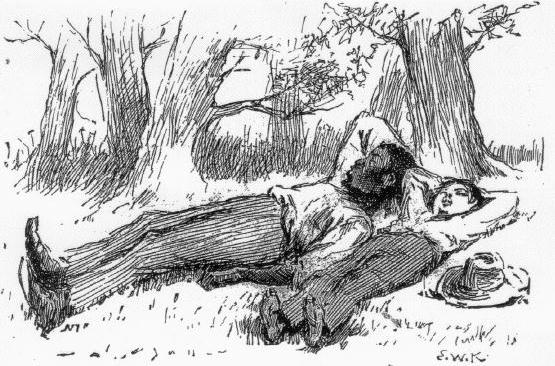
Getting a copy with the original illustrations is worth it.


3. All Other Literary Sins can be Forgiven if You’ve Read Huck Finn.

Let’s imagine that dinner parties were still things. What’s that, you say? Really? They are, huh? Weird.

OK, so let’s imagine that you’re at an actual dinner party, which is allegedly still a real occurrence. Somebody brings up Crime and Punishment, The Grapes of Wrath, The Great Gatsby, Pride and Prejudice, or one of the other few hundred novels that people wear like talismans around their necks once they get around to finishing them. You say, “You know, I’ve never actually read (insert classic here), but I read Huck Finn not too long ago, and it was fantastic; I don’t know how anyone’s ever called that a story for children." This accomplishes two vital goals: one, it immediately makes everyone around you forget that you haven’t read some other book whose title they can’t even recall at the moment, and two, it puts the pressure on everyone else listening to either ‘fess up to not having read this most seminal American work or find something very interesting across the room that they must attend to suddenly. Remember, they’re called the Culture Wars, and you need to win.


4. It’s Just So Much Fun

Let me get something out of the way: Huck Finn is not A Hitchhiker’s Guide to the Galaxy or even Slaughter-House Five. It is, however, better than both of those books and nearly as funny. But this isn’t about how funny the book is; it’s about how much fun the book is. Its cast of characters rivals (and probably trumps) anything Dickens ever put to the page, and its plot (don’t tell Twain you were looking for one) is simultaneously thrilling, frightening, hilarious, and suspenseful. For all the value I place on putting in the (sometimes difficult) work necessary to enjoy great art, Huck Finn, rich though it is, requires surprisingly little effort to enjoy. This doesn’t mean it’s simplistic, just that Twain so expertly executes his purpose that as you kick back on your porch (if you don’t have a porch on which to read Huck Finn, I suggest you engage in some minor trespassing, just to ensure the full effect), Twain’s wit and charm lift literary revelations right off the page and lay them at your feet, ready for your chewing pleasure.

Warning: If you attempt to read this novel on a summer evening while smoking a pipe, reclining near a body of water, or chewing on a stem of wild grass, you may collapse in a fit of sheer pleasure.


5. If Nothing Else...

- You need to know what all this n-word hubbub is about. That scoundrel from Auburn who’s aiming to censor Huck (and make a tidy profit from his own edition of the novel) deserves to be yelled at, but only by people who know why they’re yelling.

- It’s hundreds of pages shorter than other works that your friends have been pestering you to read. The $2.00 Dover Edition runs 220 pages, unabridged. 

- I nearly drowned a certain unnamed friend of mine in a certain famous river in a certain major British city because he admitted to never having read Huck Finn. Protect yourself from nut-jobs like me and read the damn book already.


By Josh Corman

Follow me on Twitter @JoshACorman