Showing posts with label Art. Show all posts

Sunday, April 1, 2012

Ripping Out the Roots

By Josh Corman

Follow me on Twitter @JoshACorman

We here at Verbal Infusion don't usually post such similar items in such close proximity to one another, but, then again, we here at Verbal Infusion don't always check the site prior to writing said items to be sure that just such a flap is avoided, either. In any case, we're sticking with this whole sports thing because, in all honesty, we just don't get to talk about sports very much on here, and the NCAA Tournament Championship has bought us a little leeway, we'd like to think. Enjoy.

The entire ball game, in terms of both the exam and life, was what you gave attention to vs. what you willed yourself to not.
- David Foster Wallace, The Pale King


When I graduated from high school, I was just entering the beginning stages of what I would term the blooming of my culture tree. I voraciously ingested new bands and filmmakers and authors, and they all became their own burgeoning branches, increasingly heavy with fruit—their as-yet-undiscovered debut albums and esoteric indie films and short-story collections. I couldn't get enough. This was largely by choice, but, after a while, I became a type of automaton, buying albums and movies and books because I couldn't bear the thought of not being completely up to date on the latest trends, even if I didn't really care about the individual pieces of work as I lapped them up.

This lasted until probably a couple of years after I got married. At that point, it became far less justifiable to feed my personal little culture tree for reasons both financial and temporal, and I started doing what I imagine a lot of people entering their mid-twenties do: trimming the culture tree. As much as it pained me to not race out at midnight to buy any more just-released DVDs, I soon came to terms with the change of course and found myself not much worse for wear. As my responsibilities increased, I trimmed the tree to make room for the people and things that needed my more focused attention.

It should be clear from these paragraphs that I am a reasonable person, perfectly capable of making sane, rational decisions, even about excising some of those things which, for a season of my life, I spent a probably inordinate amount of attention on. Let's all agree on that premise, shall we?

Hard to believe, but this picture is to scale.
During this whole tree-trimming period, I briefly turned my attention to sports. I say briefly, because in just about the same moment that I thought about scaling back my sports intake, I realized that it would not so much involve trimming branches as ripping out the roots of my culture tree. See, sports matter to me like very little else in my life, and when people hear a statement like that, they often have one of two reactions. The first reaction is knowing empathy. They nod and start citing sports-related moments from their youth and adolescence that provide much of the context for those times in their lives. These people are lifers, and if you find a lifer that supports the same team or teams that you do, you've probably found a friend who'll be around for a long time (obviously, having this same conversation with someone who supports a different team can render this person instantaneously insufferable).

The second type of reaction is a mixture of incomprehension and near hostility, with a dash of dismissive arrogance thrown in, like someone who took a couple of Spanish classes in high school trying to keep up with native speakers and failing miserably: they resent the people and the language they're speaking. These people, as Nick Hornby noted in his memoir Fever Pitch, simply don't get it, and it's unlikely that they ever will. They view sports as trivial and unworthy of serious consideration. In a world so overflowing with art and politics and fine cuisine and actual strife, sports simply do not warrant their attention.

It goes without saying that these people think of me much as Nick Hornby thinks of them. They would say there's something out of whack with my priorities, that all the energy and attention (and eventually money for heart medication) that I spend on sports is wasted, floating out into nothingness, an investment in a void.

And I'll admit, sometimes I feel like they're right. I mean, I've never thrown Abbey Road on and had Nickelback come out of the speakers, and I've never opened a copy of a Steinbeck novel only to find the text cruelly replaced with Sue Grafton's prose, but the equivalent happens in sports all the time. Fans invest their time and energy and appreciation into a given team or athlete, they feel like that investment will surely be rewarded, only it isn't. The pass falls incomplete, the shot rims out, the ball hits the crossbar (again and again and again, in some cases), and all those people who could have been off sampling a choice cut of steak or soaking in the hammering beauty of Beethoven are brought low by their apparently foolish allegiance to this or that squad of athletes, many of whom don't seem to bear a burden half as heavy as many of their fans. And this happens far more than its inverse. Any sports fan worth their salt has a half-dozen stories of anguish for every moment of championship-induced euphoria (excepting perhaps Yankee and young Manchester United fans). We accept this as part of the odd bargain we make as investors in these volatile, amorphous entities called teams.

But why? It's a fair question, and one I've pondered dozens of times. Hornby says it's an addiction for him. He knows his behavior is not sane, but that Arsenal Football Club simply have their hooks in him, and like a true addict, he needs the fix more than he's bothered by its effects on him. Kurt Vonnegut said we do it because we want our lives to mirror the stories we read, so we build constructs like sports to imbue them with a sense of drama, not worrying about the contrivance.

I don't know the answer, despite having lived out sports fandom as intensely as anybody I know. But I suspect that besides being fun to watch and a reminder of our youths, sports also offer us a few hours at a time when we are connected to other people through something that transcends political leanings, class, race, and any of the other hundred stratifications that make up our culture. This is not a new thought, but I think it strikes most closely to my personal experience. I've heard some argue that such connection is fabricated, that we're all just fools rooting for laundry, and that any meaning imposed upon grown people's performances playing children's games is illusory. It's a cop out to say that anyone making that argument "doesn't get it" (despite how true it is), so I'll try to counter it with something a little more potent.

Tonight, the sports team I have supported more fervently than any other will play for its eighth national championship, its third during my lifetime. When Kentucky tips-off against Kansas, I will transform into an anxiety-ridden ball of sweat, weak knees, muttered profanity, and reckless intensity. But so will millions of other people just like me. People literally around the globe will watch this game. They will cheer with me and sigh with me and no matter the outcome, they will empathize with me. I can think of precious few other things in the world about which the same can be said. Yes, millions have read some of my favorite books, but outside of the few days following the release of, say, a Harry Potter book, they aren't all doing it at the same time, suffering through the same suspense and elation and devastation that I am. Because that's a big part of what sports are: the knowledge that others care about what you care about, the knowledge that you aren't alone.

What DFW said about how we spend our attention is true, and he also said that the reason that art exists is that we are constantly attempting to make ourselves feel less alone, that the reason novels and films and poetry and music speak to people so intensely is that those are the ways in which we assure ourselves that there are other people out there like us, other people who care about the same things and experience the world in roughly the same way that we experience it. That's a wonderful thought, if you ask me, not to mention a true one. I think the same thing can be said of sports. By watching these games and following these teams, we're doing more that just escaping from our lives or killing a couple of hours; we are reaching out, knowing that other people share our joys and our heartaches and our excitement.

And that's a feeling worth chasing. If you need me tonight after 9:30 EST, I'll be running hard after it. Well, me and a few million friends.

By Josh Corman

Follow me on Twitter @JoshACorman

Monday, March 12, 2012

Cultural Inoculation, Vol 1: Five Good Reasons to Read The Adventures of Huckleberry Finn

By Josh Corman

Follow me on Twitter @JoshACorman
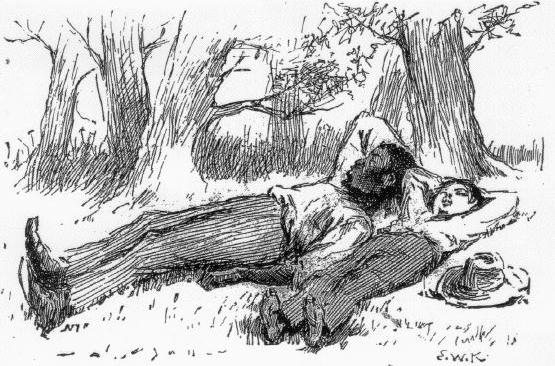
We here at the Infusion know that you want a little culture in your life. We know that’s why you listen to at least six minutes of classical music per month on that one classical station that’s kind of close to NPR on the radio dial. We know that’s why you go to bookstores and admire the covers of all those nice new Penguin editions on the “classics” table. Thankfully, you’ve got us to supplement your other, er... efforts at embiggening your inner life.

Our first cultural inoculation (little known fact: Cultural Inoculation was in the running for this site’s name, but its lack of tea-centric humor cost it dearly) involves one of the greatest works in American literary history. Now, before we get started in earnest, let me set your mind at ease. This isn’t senior English, and I’m not giving a pop quiz. Quite the opposite, in fact. There exists a very real dilemma in the lives of astute/educated/culturally aware/bookish people: we legitimately have an interest in the canon. Whether films, books, albums, paintings, sculptures, sonnets, limericks, or soup cans, we want to know what all the fuss is about regarding all those supposedly great things we see listed in magazines or blogs as “The Greatest of All Time.” Our interest in these things creates a problem because we know that we can’t possibly get to it all. Sad, but true. I mean, I’d love to spend more time watching Truffaut films or listening to Woody Guthrie recordings (seriously), but I’ve got enough on my plate keeping up with Wes Anderson and Josh Ritter. I know Truffaut is hugely influential, but what if I watch The 400 Blows and it, well, blows (if you're thinking, 'Corman's better than that joke,' you're wrong)? Then I’ve wasted valuable capital that can’t be refunded. “That’s right!” I hear you saying. “If only I had someone who I trusted implicitly to guide me through the mine field of Important Cultural Decisions (ICDs).” Well, here I am! You’re welcome, Mom (sorry, but until it’s proven to me that someone besides my mom is reading these...).

Today, I’d like to answer just one question that will make your cultural life that much easier: Should you read Mark Twain’s The Adventures of Huckleberry Finn?

Well, yes, you should. And I’ve got five simple reasons as to why.

1. Hemingway’s right, you know.

Hemingway (or Owen Wilson, if you follow Woody Allen’s version of history) famously called Huck Finn the apotheosis of the American novel. Being Hemingway, he used shorter words, but you get the idea. Point is, he’s right. Think about it: the novel is set on America’s greatest body of water, it offers commentary on one of our most important moral episodes, and was written by perhaps our most recognizable and quintessentially American author.

Now, some of you might counter my Hemingway with a seemingly appropriate Twain quote: “A classic is a book which everyone wants to have read, but no one wants to read.” The problem with using Twain as a defense in this case is that you would have to do it ironically, but since the quote itself is ironic, it cancels out, just like two negatives in that one branch of math I remember almost nothing about.

2. Huck is the Most Significant Character in the History of our Culture.

Bart Simpson. Marty McFly. Ferris Bueller. These are the great-grandchildren to Huckleberry Finn. We love the precocious, street-smart youngster who has to outwit the establishment in the name of adventure, and Huck provides the blueprint. He’s arrogant, more than a little selfish, ballsy, but ultimately can’t help doing the right thing. Sound familiar? Let’s add another character to that list, shall we: Han Solo. Bam! What red-blooded American could resist taking an adventure with the spiritual great-grandfather to Ferris Bueller and Han Solo? So what if a raft replaces the red Ferrari (so choice) and the Millenium Falcon? So what if a runaway slave named Jim replaces that whiny malcontent Cameron and Chewbacca? Abe Frohman, Sausage King of Chicago, and the captain of the ship that made the Kessel Run in less than twelve parsecs would be disappointed in you for worrying about sexiness over substance. So go forth, hop aboard the raft with Huck, and spend a couple hundred pages with a mostly naked, nearly illiterate thirteen-year-old who smokes like a chimney. (Wait, did I just undercut my case? Moving on.)
Getting a copy with the original illustrations is worth it.


3. All Other Literary Sins can be Forgiven if You’ve Read Huck Finn.

Let’s imagine that dinner parties were still things. What’s that, you say? Really? They are, huh? Weird.

OK, so let’s imagine that you’re at an actual dinner party, which is allegedly still a real occurrence. Somebody brings up Crime and Punishment, The Grapes of Wrath, The Great Gatsby, Pride and Prejudice, or one of the other few hundred novels that people wear like talismans around their necks once they get around to finishing them. You say, “You know, I’ve never actually read (insert classic here), but I read Huck Finn not too long ago, and it was fantastic; I don’t know how anyone’s ever called that a story for children." This accomplishes two vital goals: one, it immediately makes everyone around you forget that you haven’t read some other book whose title they can’t even recall at the moment, and two, it puts the pressure on everyone else listening to either ‘fess up to not having read this most seminal American work or find something very interesting across the room that they must attend to suddenly. Remember, they’re called the Culture Wars, and you need to win.


4. It’s Just So Much Fun

Let me get something out of the way: Huck Finn is not A Hitchhiker’s Guide to the Galaxy or even Slaughter-House Five. It is, however, better than both of those books and nearly as funny. But this isn’t about how funny the book is; it’s about how much fun the book is. Its cast of characters rivals (and probably trumps) anything Dickens ever put to the page, and its plot (don’t tell Twain you were looking for one) is simultaneously thrilling, frightening, hilarious, and suspenseful. For all the value I place on putting in the (sometimes difficult) work necessary to enjoy great art, Huck Finn, rich though it is, requires surprisingly little effort to enjoy. This doesn’t mean it’s simplistic, just that Twain so expertly executes his purpose that as you kick back on your porch (if you don’t have a porch on which to read Huck Finn, I suggest you engage in some minor trespassing, just to ensure the full effect), Twain’s wit and charm lift literary revelations right off the page and lay them at your feet, ready for your chewing pleasure.

Warning: If you attempt to read this novel on a summer evening while smoking a pipe, reclining near a body of water, or chewing on a stem of wild grass, you may collapse in a fit of sheer pleasure.


5. If Nothing Else...

- You need to know what all this n-word hubbub is about. That scoundrel from Auburn who’s aiming to censor Huck (and make a tidy profit from his own edition of the novel) deserves to be yelled at, but only by people who know why they’re yelling.

- It’s hundreds of pages shorter than other works that your friends have been pestering you to read. The $2.00 Dover Edition runs 220 pages, unabridged. 

- I nearly drowned a certain unnamed friend of mine in a certain famous river in a certain major British city because he admitted to never having read Huck Finn. Protect yourself from nut-jobs like me and read the damn book already.


By Josh Corman

Follow me on Twitter @JoshACorman

Wednesday, February 22, 2012

The Destructor: An Open Letter to Malcolm Gladwell

By Josh Corman

Pictured: Smug Bastard
Follow me on Twitter @JoshACorman

Dear Mr. Gladwell,

Curse you. And that’s just for starters.

Your books have made me seriously reconsider what I know and think about the world around me, and, frankly, I feel violated. Have you any idea just how long I strolled about my day to day life, absolutely self-assured and totally confident that I knew everything worth knowing? A long damn time, sir.

I knew how to fill out an NCAA Tournament bracket, how to parent, and how to bluster knowingly in the directions of intensely bored friends about crime, education, business, and politics. But that’s all crumbled now, thanks to you. Now I bluster about the things you think.

If you suspect that I am somewhat to blame for the sad state I find myself in, that I simply could at any time stop reading your books and your New Yorker articles and the interviews you do and thus spare myself the indignity of being shown up as someone who understands very little (but proclaims to know quite a lot) about the world around me, then I take offense at that typically arrogant insinuation. How can I stop? You see, only by continually investigating your “well-researched” and “insightful” works will I ever find the critical mistake, the half-baked error that will invalidate all of your “wise” and “transformative” and “mind-bendingly revealing” drivel. Yes, I must soldier on.

Or so my thinking went.

One day last week, I pulled up a video of a speech you had given at a TED conference in 2004. I was searching for a short but rhetorically effective display of deductive reasoning to show my AP Language and Composition classes, and, in my poor judgment, I played your “Spaghetti Sauce” speech for my unsuspecting students. While they were largely unaffected (the coming generation has thankfully been immunized against exercising their capacity for abstract thought in all but the direst circumstances), I was once again traumatized and affronted.

In that speech, when you summarize the work of Howard Moskowitz , you extol the virtues of “horizontal segmentation,” wherein the largest possible number of people have the greatest chance at happiness when they abandon the Platonic ideal of one perfect choice. Instead, you suggest that they embrace the idea that no spaghetti sauce or mustard or olive oil is intrinsically better than any other, only that there are sauces and mustards and olive oils better suited to their individual tastes. I then (as I assume was your nefarious goal all along) applied this logic to my own choices.

Traumatized and affronted, sir. Traumatized and affronted.

Of all the other deeply held convictions you have made me question, none has horrified me so completely as this. I have impeccable taste. That taste is rooted in years of placing every conceivable song, film, book, album, score, and short story into a painfully crafted hierarchy of perfection. And from the top of that hierarchy I looked down at Stephanie Meyer and Nickelback and Drew Barrymore and I laughed, sir. Sometimes in pity, sometimes in rage, but always from the safety of my ivory tower.

Your implied suggestion that, in fact, relentlessly mocking Twilight and Two and a Half Men and Michael Bay’s films is not a beneficial and worthy use of my time, and that I should instead simply recognize that the people who enjoy things that I dislike are not actually brainless slugs whose very existence signals the apocalypse’s imminence appalls me. What else am I supposed to do with my time?

I have spent hundreds of fruitless hours in circular debates in which nothing is concluded but the friendships of those involved. If you claim that these have been a waste, you call into question my intellect, my behavior, perhaps even my sanity.

I’ve spent much of my life making sure that I am right, but now, all of a sudden, I wonder whether or not I actually am. Or if it's even possible to be "right" when it comes to matters of taste.

How dare you.

By Josh Corman

Follow me on Twitter @JoshACorman

P.S. - To better prepare your defenses against Malcolm Gladwell's devilish schemes, watch his "Spaghetti Sauce" speech.

Wednesday, October 5, 2011

Hard Work, Great Art: The Radiohead Effect

by Corman

Sometime during my freshman year of college, when my musical curiosity was only just blooming, I illegally downloaded a bunch of Radiohead songs. The band had just released Hail to the Thief, and every music publication and grumpy record store clerk (is there any other kind?) that I consulted was preoccupied with the album and the band that released it, so naturally I became preoccupied with them too. If I liked their stuff, I would support them by purchasing their records. If not, I could erase the files and pretend the whole thing never happened.

At this point, I couldn’t have named a single Radiohead song, so when I started downloading their music, I stuck to the albums that most frequently showed up on the “Best-of” lists in those aforementioned publications: The Bends, OK Computer, and Kid A. I don’t remember the exact point when I actually became afraid of what I heard, but I’ll wager it was somewhere during “Idioteque,” a stuttering electronic spasm of a song that sounded nothing like the blues-based rock I ingested by the gallon in those days.

This? I thought. This is the greatest band of their generation? Who did these guys bribe?

But then, I started to worry. What if it’s me? What if they really are great, but I just don’t “get it?” What am I missing? This sort of self-criticism is, I think, pretty natural any time a work of art is praised and awarded high status but doesn’t resonate personally. At the time, though, I was haunted just trying to figure out which of my reactions was closer to the mark. Were the critics and fans just fooling themselves into crying “classic” because they wanted so badly for it to be true, or were my critical faculties not sophisticated enough to understand what I was listening to?

To be safe, I did what any intellectually astute young man faced with such a quandary would do: I ignored it. I shelved the whole Radiohead experiment, intent on proceeding with my Beatles and my Hendrix and my Pink Floyd.

But, oh, how it gnawed at me. I was pulled time and again back to Radiohead’s music no matter how I resisted, even going so far as to buy copies of a couple of their early, much more listener-friendly albums. They repelled me, then drew me back in, pushed me away and beckoned me again until one day, almost five years after I had first listened to their music, everything fell into its right place. I saw Radiohead in concert during the summer of 2008 and was blown away. It was like I had spent those five years wrestling with a complicated equation, and on that night, I finally solved for X. They played the hell out of every song, even the ones I was less familiar with, the ones that had scared me off years earlier. Suddenly, they just made sense. Part of it was the energy behind the performance (it’s easy to forget with all the electronics that the band actually plays all of those songs), but I think mostly it can’t be qualified.

That performance sparked Radiohead’s ascent to their current status as my favorite active musical artists. I eagerly anticipate the release of every new album and single. I salivate over the rumors of a 2012 U.S. tour. I adore this band and their music.

But all of this came very close to never happening. My initial urge to dismiss the band’s status as a byproduct of the hipster hype machine very nearly won out, and if it hadn’t been for that little niggling urge that drew me back to something I hadn’t originally grasped, it would have. And then where would I be? Who would I be? Does the question seem ridiculous? It shouldn’t, not if you believe that, at least in part, our identities are in some way shaped by the art we love. Or, at least, the types of art we love.

Let me explain. My Radiohead example is just one of many from my life. Often I have encountered albums, novels, films, and even television shows that have taxed and perplexed me. My initial reaction is always, no matter how “sophisticated” I think I’ve become, to push the art away, write it off as pretentious. But the good stuff, just like Radiohead, responds in kind. It calls to me, invites me back, slowly reveals a beauty or poignancy or sharpness that was hidden during our first encounter. Eventually, I had to concede that my first impressions could not be trusted, and while some great art does not require this level of, for lack of a better word, work, all great art rewards our persistent efforts at relating to and interacting with it.

I understand that some don’t see it this way. Many believe that art should meet you where you are, and if it doesn’t speak to you immediately, then that probably means it never will. These people look, like I once did, at what they don’t enjoy or understand (though they are often loath to admit the latter) with disdain, unable to grant even the possibility of value. This view is easier, but it is not best practice.

I don’t mean that we might, if simply enough effort were expended, come to enjoy everything. Our tastes will still direct us to that music and writing and film which resonates with us, but we must rely on more than simple taste. We must be willing to wrestle with and even struggle through difficult, challenging works to mine from them the value within.

The reward, though hard won, is inestimable. The reward is Vertigo and There Will Be Blood, The Brothers Karamazov and Infinite Jest, In Utero and The Age of Adz, The Wire and Twin Peaks. The reward is engaging with some of mankind’s greatest achievements and coming out the other side enriched, fulfilled, and maybe even changed.

I don’t know what’s out there waiting for you, but the only way to find out is to get to work.

Normally, I would end there, but I’d like to invite my fellow Verbal Infusers to take a crack at my central question: How hard should we have to work to appreciate great art?