Showing posts with label film. Show all posts

Monday, April 23, 2012

Swan Songs

By Josh Corman

What If?

What if John Lennon had been shot in 1969 rather than 1980? What if, just weeks before the release of Abbey Road, the most significant member of the most significant musical group in history had left this world? And what if, instead of leaving behind a fully recorded, mixed, and mastered piece of visionary art, John had struggled to finish some of his compositions. What if only half the vocals had been laid down, or what if he had never quite been satisfied with the guitar on "Come Together?" What would the rest of the group have done? What would the release day for Abbey Road have looked like if fans knew, beyond any doubt, that the last glimpse into John Lennon's genius, moving full steam ahead, would come on October 1st, 1969, and that it really didn't look like what he would have wanted out there?

What a shame it would have been, obviously. It's sad enough when a towering creative figure dies at the end of a long, productive life and career, or even when they die young, but with their best creative days likely behind them. But when a Kurt Cobain or James Dean goes, right at what should be the apex of what they've striven to give the world? We listen to that last record or watch that last film, and we search for something, some flicker of the promise we know we've lost, and it comforts and pains us all at the same time.

The Pedestal


The most fascinating novel ever written about taxes and accounting.
For a number of reasons, I looked forward with near unhinged madness to this year's Spring Break. Besides all the usual perks of a work-free week, I had been saving something very important: David Foster Wallace's final novel, The Pale King. The combination of wild anticipation and anxiousness with which I had looked forward to reading Wallace's final work (he committed suicide in 2008 after a long, troubled battle with depression and addiction) was something that I hadn't experienced since reading the final Harry Potter novel in 2007. In that case, I was only anxious because I wanted so badly to love the story and discover the answers to questions I'd been asking for years. The Pale King brought with it a different layer of emotion. This was the last time I would read a novel by one of my three favorite writers of all time, and knowing you're losing a character doesn't feel nearly as bad as losing an author. I had devoured Wallace's previous two novels, The Broom of the System and Infinite Jest, near the beginning of last year and read one of his two nonfiction collections, Consider the Lobster, the previous Christmas. In the time between reading those works and opening The Pale King, I had watched approximately ten hours of interviews with Wallace, read his Kenyon College Commencement speech, "This is Water," probably fifteen times, and gobbled up every interview, profile, and review I could find written about the man or his work.

This is dangerous behavior. I'd put DFW on a pedestal. Rarely, if ever, does anything good come from putting a writer, musician, actor, or sports star on a pedestal. Creating hopelessly high expectations (especially for a dead person) leads mostly to deflation and letdown because of the narrow pathway it leaves for our idols to tread. Take Cobain as an example (my Verbal Infusion contract requires me to make mention of Nirvana or Kurt Cobain no fewer than twenty times per year; I'm trying to add a few tallies to that ledger). When In Utero came out, a lot of people were disappointed with the record's raw sound, but that disappointment didn't really stem from the quality of In Utero. Rather, it was that In Utero didn't sound enough like Nevermind for many fans' tastes. They had created a Platonic version of Nirvana in their minds, and when In Utero didn't mesh with that narrow conception of what the band should be, they reacted unkindly. History has a way of salving the sting in most instances like this (and it certainly has for Nirvana's second album), but time and again the pedestal effect plays itself out.

And so, having placed The Pale King on a pedestal next to its author, setting aside a week to read it during which I would have plenty of time and focus to spare and essentially creating an environment in which the book could do little but disappoint me, I finally read the thing.

Man, did it hurt. The Pale King is funny, poignant, and philosophical, and it shows flashes of brilliance that even Steinbeck can't match for their harrowing, pummeling pathos. And now, 560 pages later, it's all gone. I knew this ache would come. The effect of feeling, for real, that I would never get to engage with this voice (in this form, at least; Wallace has short fiction collections and one more nonfiction collection that I'm working hard to create pedestals for) in a fresh way again. It doesn't feel like regret, exactly, but it stings in kind of the same way.

The Afterglow


One of the hardest feelings for me to describe to people is that of having just finished a book that you know is going to stick with you for a long time. The words are simultaneously buzzing around in my head, striving to leave a singular impression and quickly fading from memory. What's left is usually just a holistic impression that feels unworthy of the massive effort that you know went into what's been read.

My immediate holistic verdict was one of gratitude and awe. Gratitude because when Wallace died, his editor put a tremendous amount of work into marrying the three hundred or so neatly typed pages that represented the most complete part of The Pale King and then cobbling the rest of it together using found notes, rough drafts, and computer files. The result is, as the cover indicates, unfinished, a word that only adds to the ache I mentioned earlier. The awe I felt wasn't new. The way guitar players are in awe of Hendrix or Morello, poets in awe of Whitman or Eliot, actors in awe of Brando or Lewis, that's the feeling even two or three consecutive DFW sentences make me feel. The fear that "unfinished" meant "lacking quality" vanished pretty quickly. The Pale King met the immense challenge I had set for it, but it made me wonder about what will come next.

David Foster Wallace is my John Lennon (even though John Lennon is also my John Lennon, he was dead five years before I was born, so it doesn't work the same way), my Kurt Cobain, my James Dean. He left behind a few thousand pages, and as I've worked through them, I've thought about this end point often. The way I see it, I've got one of two choices: I can convince myself that finishing Wallace's last novel is tantamount to losing a best friend, develop an unhealthy literary solipsism where I see everything through the DFW lens, thereby ensuring that I hate ninety-five percent of what I read because it doesn't measure up, or I can acknowledge that it's been a hell of a ride, that my twelve pound copy of Infinite Jest isn't going anywhere, and that Wallace will always be there, waiting to be reread and rooting for me to find something that's just as great as he was. Instead of being bummed or even afraid because I've read his every word, I should just appreciate what he gave me and move on.

That second choice is really the only choice for us, if we want to enjoy our favorite pastimes, but I don't know if it's the one we choose most often. If you saw the story in the news about the Tupac Shakur hologram closing out Dr. Dre's set at the Coachella music festival last weekend, you might understand what I mean. Tupac was a titan of his field, to be sure, and for much of the last seventeen years, a lot of hip-hop fans have been hung up on what his loss meant, and what his death cost in terms of his art. It's a callous way to approach the loss of a life, but when we lose an artist, it's hard not to think about their work first, because it's really the only connection we have to them.

The concept of a rapping Tupac hologram is weird, but it's also frightening. Dr. Dre, the man who dreamed up the idea, has said that this is only the beginning for this technology and that there are plans to send the hologram on tour. How long do you think it took for someone to call Yoko Ono's or Courtney Love's agents and pitch the idea of a Beatles or Nirvana reunion. I can only pray that neither one of them would have the audacity to give such a plan the thumb's up, but until I hear a definitive "no," I'm going to be a little nervous. But there are those who might get excited at the prospect. I am afraid of these people.

See, I don't want to be somebody who can't let go. I won't ever read a new David Foster Wallace novel or listen to a new Beatles record or see a new Heath Ledger movie, and I need to be okay with that. Increasingly, I think I am.

By Josh Corman

Follow me on Twitter @JoshACorman

Friday, March 30, 2012

March Madness and Movie Magic: A Deconstruction

Jonny Walls

When I play video games, I experience thousands or millions of lines of code. There are no creatures, no characters, no spaceships, no swords, no glistening lakes, no foreign planets or magical forests. Just code.

When I read a book, I'm looking at thousands of letters grouped together in particular sequences on multiple pieces of paper. No people, no stories, no feelings, no dialogue. Just ink and paper.

When I watch a movie, I'm witnessing the result of light hitting a sensor and burning into a piece of film. No explosions, no kisses, no life or death scenarios, no sexy glances. Just film.

When I watch basketball, I'm seeing a bunch of guys I've never met, who were in elementary school when I was in college, playing a game. I'm watching them throw a rubber ball through a metal hoop, and hoping one group of kids manages to do it more than the other. No warring cities, schools, or states. There is no actual school or state pride on the line. Just kids, rubber, and metal.

These assessments may seem harsh, but they're generous by deconstructive standards. Like it or not, it's cold truth.

How about this? When I watch a basketball game and my blood starts pumping and I know in my heart that I will be genuinely disappointed if the game doesn't swing my team's way, I am knowingly basing my own happiness upon whether or not the collection of particles that make up the people who wear the collection of particles that form my team's uniforms can throw the collection of particles that takes the form of a ball into the collection of particles that is a rim more times than the opposing group of particle collections.

But that doesn't feel right, does it? That completely true description paradoxically fails to tell the truth of the life that we know. Whether it's video games, literature, film, or basketball, the elements of this life take on greater meaning than the sum of their individual parts. We "irrationally" relate to the characters on screen or the players on our favorite team because there is something in them that is also inside us, be it an eerily familiar disposition or the simple willingness to represent one's home state.

Relate to Scott Padgett or he will eat you.

Hoops and Hollywood

When a great basketball team is firing on all cylinders, it becomes like a living, organic, flowing being, greater than the sum of its parts. Each part of the organism plays its role to perfection, and the result is like Life. But we must suspend our disbelief just a touch to see it. If we don't, we'll see nothing more than boys in uniforms throwing a rubber ball.

For a film to make us forget the real world, all of the pieces must work together seamlessly: lighting, choreography, acting, sound, costumes, makeup, etc. If it fails, we see actors in front of a camera surrounded by a crew, but when it works, it becomes surprisingly easy to suspend our disbelief.

Funnily, we tend to selectively align our skepticism and liberality of belief with what most pleases us, and are quick to scoff at those who align it differently. I know people who have cried watching a person they know to be a living actor pretending to die in front of a camera as a different person, then turn around and ridicule sports fans for caring about the outcome of a sports match. I have likewise known avid sports fans to ridicule fiction and story lovers for their so-called love of escapist fantasy.

Is it really so different if a Red-Sox fan suddenly sees Johnny Damon as a different entity when wearing Yankee Blue? Is it not a similar phenomenon when a film lover sees a different Matt Damon when he's playing the angel Loki and when he's Jason Bourne?

The Answer Was Inside Us All Along

We get to be genuinely, emotionally moved by films and truly excited and elated (or disappointed, forlorn...crushed) by sports by suspending our disbelief, but neither would work if they didn't tap deeply into the intricacies of our inherent natures. Selflessness, beauty, struggle, physicality, desire, agony, defeat—these powerful aspects of life are on display in every decent film and every worthy game of basketball, so we can be forgiven when we conveniently forget that we're not actually part of the team we adore, or that Frodo is really some kid from Iowa.

Art and sports work because, literally, we have infused them with meaning. It's a certain fluid, flexible, lowercase meaning, but it's meaning nonetheless.

Look at yourself and your loved ones. A collection of separate particles, every one of you. But we have meaning because we have been infused with it. Deconstruct us all you want, down to the last quark, but almost no one would disagree that we are greater than the sum of our parts, and I say it's because we were made so.

Breaking the Fourth Wall

An important caveat lies simply in the word "imitate." Art and sports work because they imitate, but they fall short for the same reason. As ridiculous as it may sound, it's quite easy for, ahem...certain types (read: myself and most of my friends) to lose sight of the line between imitation and real life. I've lost myself in a novel or video game world for days at a time, and I've lost sleep over more than one impending UK basketball game. In fact, as UK's monumental Final Four match-up with Louisville looms, I have found myself fighting off pangs of anxiety with a steady stream of self-reminders: "It's just a game. It's just a game." In truth, it's more than a game, but it's still just a game. You know what I mean? Paradoxical, perhaps, but then again, that's life.

This weekend, if you tune in to the Final Four, go ahead and suspend your disbelief. Relate with your team and choose to get caught up in the drama. Hope your team wins. I know I will. But don't kid yourself; it's only an imitation.

By Jonny Walls


For more on basketball and life, check out my Dad's new book.


Wednesday, February 15, 2012

The Phantom Menace and Me: Reminiscences from a More Civilized Age

By Josh Corman

Follow me on Twitter @JoshACorman

Every time I looked at this poster in 1999, I got cold chills.
One May afternoon when I was in the eighth grade, my mom surprised me with news that later that evening (on a school night, no less) we would be attending a midnight screening of Star Wars, Episode I: The Phantom Menace. This news nearly incited joy-induced heart palpitations. I had never been to a midnight screening, for one, so this all felt very exotic. Plus, I (like every other Star Wars nerd in Christendom) had been feverishly awaiting George Lucas' return to a galaxy far, far away. In many ways, the opening of The Phantom Menace was the first truly meaningful cultural experience of my life.

I thought about writing a review of TPM for you, done from the perspective of my thirteen year-old self, but a) It would be in all caps and b) I think there's a statute concerning the number of times the words "awesome" and "lightsaber" can legally appear in one paragraph, and thirteen-year-old me would violate it severely. Instead, I'll offer only reminiscence.

When we left the theater, my mom was understandably exhausted, but that didn't stop me from sapping what little will to live she still possessed by recounting all of TPM's most exhilarating scenes, frame by frame. I was blindly, wildly elated. Jake Lloyd's suspect delivery of some suspect dialogue didn't phase me. The out-of-left-field "the force is the result of something called a midi-chlorian count" element didn't phase me. Jar-Jar Binks? Didn't phase me. Not even a little.

But such is the luxury of being thirteen. I wasn't worried about little things like acting, writing, direction, and specious plotting. My concerns had more to do with lightsabers and the myriad ways in which the Jedi use them to dispatch legions of Trade Federation droids. When I got to school the next day, I touted the film's merits and gloated incessantly about seeing it before any of my friends. I had them salivating by day's end. And the next day, after they'd all gone out and seen it for themselves, we became a little chorus of awe-struck adolescents, rehashing each of the film's most pivotal moments and prognosticating on how all of these loose threads would tie together when the gap between Episodes I and IV was bridged.

Since none of my friends were film critics or thirty-seven–year–old men who'd imbued the original trilogy with way too much personal and emotional significance, it took a long time for me to temper my consideration of TPM. Ahh, the wonders of teenage solipsism.

Eventually, though, the points I heard people make about Jake Lloyd's acting and the hokey dialogue and Jar-Jar's distracting goofiness level started to make a lot of sense. As the years rolled by and Attack of the Clones approached, I was convinced that TPM had been an aberration, that the closer we got to Anakin's turn to the dark side and the destruction of the Jedi, the films would recapture some of the dark edge that made The Empire Strikes Back my favorite movie of all time. I turned out to be very, very wrong, but even after the warnings of TPM, I didn't realize it right away.

For probably a month after I first saw AotC (remember that I'm sixteen at that point), I defended it ferociously. I played down the overly saccharine love scenes—complete with botched CGI—and extolled the darkening story arc, the emergence of Christopher Lee's Count Dooku, learning the origins of Boba Fett, and finally getting to see Yoda wield a lightsaber. Even those elements soon lost their luster, and I gave up trying to defend George Lucas, instead slipping into the easy cynicism of a jaded nerd.

I won't pretend that I didn't still get excited for Revenge of the Sith three years later. No matter what happened, I was going to get some plot resolution that I'd been waiting more than six years for, and I hoped beyond hope that Lucas could work his magic one more time and save this wreck from capsizing completely.

There's a lot to be said for RotS, but the roots of that cynicism I had adopted grew deep. I began to poke holes much more quickly, and though I still think it's the best of the prequel trilogy, my estimation of it is not notably greater than the other two.

The great lesson in this little bit of personal history is not, despite what a great many Star Wars fans have written and said, that George Lucas botched one of the greatest cinematic opportunities of his, or anybody else's, lifetime. The lesson, for me at least, is that the Star Wars prequel trilogy represents a kind of descent for me, a descent into something more hard-hearted and less accepting, more bitter and less freely adventurous. In those three year gaps between movies, I went from being a middle-schooler to a high-schooler to a college student. My intellectual maturity and many of my critical faculties sprouted during that time, and what came with that was a sharper ability to appreciate and analyze art. The upside of this is obvious, but there's a downside, too.

The downside is that I end up feeling very much like Susan in The Chronicles of Narnia. I might look back on that midnight screening of The Phantom Menace and know, intellectually, that I was incredibly excited to see that film, but I can't really connect to those feelings in any meaningful way. I've left that version of myself behind, and while there are a fair few reasons to be thankful for that, there are a least a few reasons to mourn the loss. I've long since lost the capacity to approach films with that same barely suppressible exuberance, and that's a real shame.

Now, when I see commercials for the 3-D re-release of TPM, I simply scoff at Lucas' brazen and unnecessary ploy to suck more money from the pockets of the people who have spent a lifetime fueling his outsized hubris by watching his films.

And then I feel ridiculous, like an old man shouting at kids to get off his lawn. Am I so bitter about one filmmaker's mishandling of a beloved story that I can't even imagine a reality in which he just wants some thirteen-year-old—some kid who wasn't even born while I was wide-eyed and gaping as twenty-foot-tall images of the noble guardians of peace and justice in the galaxy flashed before me—to have a chance at experiencing a story that has been such a wonderful part of so many people's lives?

Lord, I hope not. I hope, in fact, that I can summon the urge to go back and watch TPM again, maybe even in theaters, just to feel that rush as Obi-Wan Kenobi flies at Darth Maul, lightsaber raised, delirium in his eyes.

Actually, I'm getting kind of excited just thinking about it.

By Josh Corman

Follow me on Twitter @JoshACorman

Thursday, January 5, 2012

Death of the Cool: A Defense of Cameron Crowe

One of these things is not like the others.
Follow me on Twitter @JoshACorman

By Josh Corman 

I once tried to write about Cameron Crowe.

What I Wish Had Happened: I poured myself a drink, brought a stack of records to the desk, threw on side one of Bruce Springsteen’s Darkness on the Edge of Town, cracked my knuckles, and typed without stopping (except to flip the record or raise my glass, of course) on my Smith-Corona Galaxie XII typewriter until I had produced nearly 2,000 flawless words about a man in whom I am very much interested, the venerable Mr. Cameron Crowe. 

You see, if I were writing about Cameron Crowe, I would have to get myself into a Cameron Crowe state of mind (or so the logic went). 

What Really Happened: I curled up in my bed, secluded (the better to concentrate, I told myself), intent on writing about Cameron Crowe. No drink, no vinyl, no typewriter. There may have been 2,000 words somewhere along the line, but most of them are deleted. Three or four different false starts later, I finally scrapped the piece and rescued something from my “works in progress” folder and shaped it up for a residence on this site. 

What’s Happening Now: More than a month later, I sit at my desk, having at it one more time. Drink: yes. Records: no (iTunes will have to do). Typewriter: Never even owned one. Cameron Crowe: Finally, yes. 


“The only true currency in this bankrupt world is what you share with somebody when you are uncool.”

Go ahead, read it again.

One more time. Seriously.

If you’ve got guts, read it aloud.

I’ll give you a minute.

...

Let me just tell you that there are some things I wish that I’d written. As far as single sentences go, that one is at the top of my list. The profound sense of envy I feel about not having written that line is compounded by my even more profound envy I have towards the person who actually did write it. You guessed it: Cameron Crowe.

The bastard.

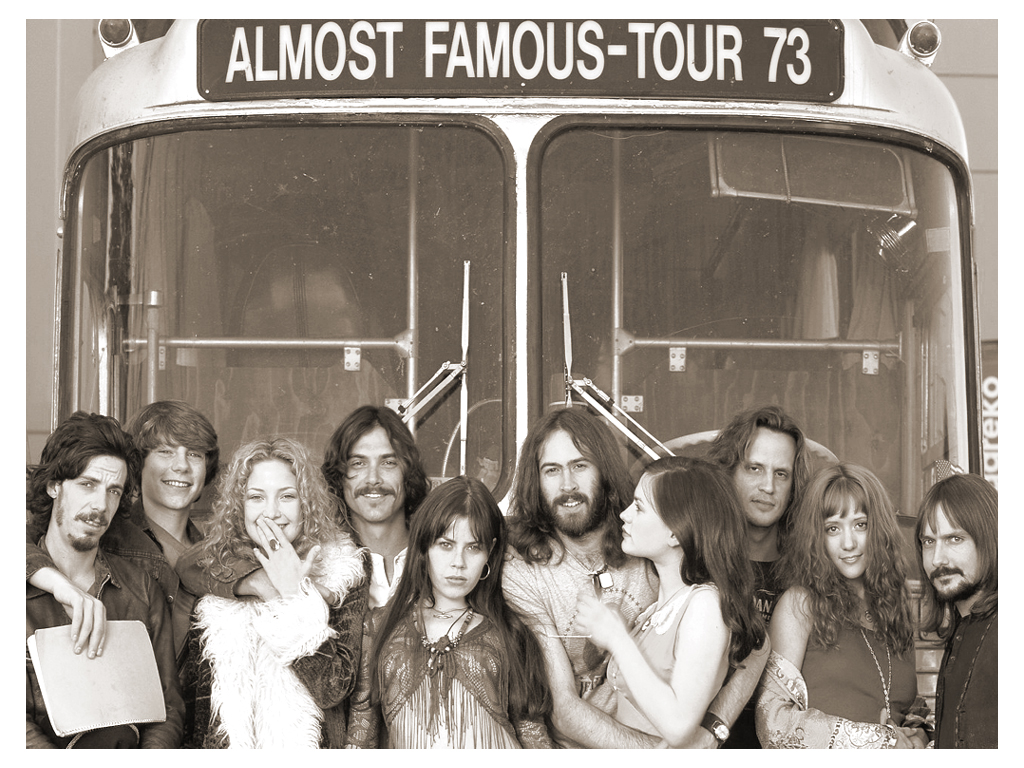
The line, delivered by Philip Seymour Hoffman’s note-perfect Lester Bangs, comes from Crowe’s magnum opus, Almost Famous, which loosely recreates Crowe’s teenage years when he scored a job writing for Rolling Stone and toured the country with The Allman Brothers’ Band, Led Zeppelin, Neil Young, and The Who. OK, so envy doesn’t adequately describe the feeling. I actually feel wronged by Cameron Crowe, like he’s cheated me out of experiences that I might have, nay, should have gloriously lived out if I had been a fifteen-year-old prodigy in Southern California in 1973. I should hate the guy, right? I should find his films insufferable or pretentious. The schadenfreude potential is enormous, folks.

But I actually kind of love him.

And it isn’t that Crowe is a particularly great director. He’s good, certainly. He’s got a (usually) deft ear for clever dialogue (Lloyd Dobler’s career speech in Say Anything; most of Jerry Maguire and Almost Famous), he’s crafted his share of memorable moments (Say Anything’s so-iconic-as-to-have-suffered-the-unjust-fate-of-becoming-overrated “boombox scene,” the “You had me at hello” and “Show me the money!” scenes from Jerry Maguire, the “Tiny Dancer” scene from Almost Famous) and characters (Dobler; Maguire, nearly everyone in Almost Famous), and he’s got a bold streak to boot (Vanilla Sky).

Despite this respectable accumulation of artistic achievement, Crowe routinely falls short of greatness. His movies are almost always too long, the plots are frequently circuitous to the point of distraction (even his masterpiece is guilty, though I’m charmed rather than annoyed by it in that case), and he’s drawn stilted performances from his lead actors on more than one occasion (Renee Zellweger in Maguire, Orlando Bloom in Elizabethtown). Even his oft-praised encyclopedic knowledge of—and deep-seated love for—pop music has grown into as much of a crutch as a weapon.

So he’s what, a middle-aged director with a huge stack of vinyls who charts at the high end of average and who only puts out slightly more than two films a decade?

Well, no. Not quite. That is, he may be those things, but he also possesses at least one other salient quality that keeps me from dismissing the guy as a one and two-halves hit wonder as some of the “serious” film-going world has. The best illustration of this particular quality is Crowe’s much-maligned (as in, the professional and amateur film critics of the world got together and voted to enact a social mandate threatening a public flogging to anyone who expressed genuine appreciation for this film; see M. Night Shyamalan’s The Village) 2005 pet project, Elizabethtown.

The movie tells the story of a prodigal son’s journey (warning!) to retrieve his father’s body (repeat: warning!). On the way, he meets a quirky flight attendant (WARNING!) who opens his eyes (For the love of God, somebody do SOMETHING!) to the spirit of adventure and empathy (CRASH!), and leads him via mix-tape on a cross-country journey of self-discovery. (That sound you hear is the orchestra still playing as the icy water slowly fills the ruptured hull of the Titanic.) Elizabethtown is, by any measure, an act of self-indulgent directorial gluttony. I should hate this movie, just like most people do.

But I actually kind of love it.

That quality of Crowe’s I mentioned earlier can best be described as a painfully earnest desire to get to the root of what makes us afraid of the world around us, and it positively drips from Elizabethtown. Orlando Bloom’s character (Drew Baylor) is emotionally able to go on his film-ending road trip only after suffering a spectacular, career-ending failure, being harassed by his family into realizing that he barely knew his father, and having all of his sophisticated affectations exposed by a series of people who challenge the one thing he clings to most fiercely: his coolness. There, I suspect, lies some of the explanation for the vitriol surrounding Elizabethtown. We see movies where a loss of cool is necessary for a character’s self-realization as trite and cheesy. As the parent of a two-year-old, I can vouch for the stunning number of children’s movies in which this same general character arc is present.

If the connection seems flippant, I’m sorry. It isn’t meant to be. We associate the themes Crowe so often explores as childish and unworthy of serious adult consideration, especially when they’re explored as un-ironically as Crowe does in his films. I say films because when I think about it, every film of his that I’ve seen (all but Singles and the newly released We Bought a Zoo) features a character who is stripped of his cool on his way to the tale’s climax. In Say Anything, it’s Dianne (Ione Skye’s character) whose Class President sheen is stripped away as she fumbles her way through normal social experiences and her relationship with her father crumbles. Jerry Maguire falls from grace and is rescued from professional and relational hell only after making a fool of himself on a grand scale and realizing that he isn’t too good for his wife. Both Penny and Russell in Almost Famous are nearly reduced to rubble before their epiphanies arrive. Even in Vanilla Sky, a film he didn't write, David Aames is brought low from his days as an invincible playboy by a relationship he plays a little too coolly.

Why does any of this matter? How does it make Cameron Crowe anything more than a mediocre director who’s a total sap on top of everything else? It matters because I hold a special place in my heart for people who really, violently mean what they say, even when what they say is on the hokey side. It’s the same reason I love Bob Dylan and Neil Young despite the considerable gap between their artistic ambition and the quality of their voices. They mean what they sing so intensely that their depth of feeling overcomes flaws that seem more and more inconsequential the more you listen to their music.

If Dylan and Neil were cool, they would never have opened their mouths. If Lloyd Dobler were cool he would have never blasted “In Your Eyes” from that boom box to a girl who’d broken his heart. If Jerry McGuire were cool, he never would have saved his marriage. Russell Hammond wouldn’t have given William that final interview. Drew Baylor never would’ve truly appreciated his father. These people can't be saved as long as they're cool. Cameron Crowe believes fundamentally that coolness is a false currency, a shield that we use to protect ourselves from the most frightening, vital aspects of the world around us, and he can’t help but show us how fervently he believes it, over and over again. You know why? 


Because Cameron Crowe is uncool.

By Josh Corman

Follow me on Twitter @JoshACorman

Sunday, October 30, 2011

Psycho: Expectation and Inevitability

By Josh Corman

As Hitchcocktober comes to an end this Halloween, it's only appropriate to take a nostalgic look back at Hitch's most frightening film, Psycho. If you're one of the few stragglers who hasn't seen this wonderful film, I warn you that SPOILERS FOLLOW.

Now then, critical evaluation of Psycho is, at this point, a fruitless venture. So much has been said, written about, and filmed concerning Hitchcock's most recognizable and popular work that to revisit it in that capacity would resemble nothing so much as a parrot ineffectually reciting half-remembered lines from an AFI broadcast.

Anybody older than ten years old with any knowledge of American film history knows three things: One, life is like a box of chocolates. Two, Darth Vader is Luke's father. Three, there is a shower scene in Psycho. It ends badly.

I too knew all three when I first watched Psycho, but I knew almost nothing else about the film or its maker. I had seen The Birds (Hitchcock's other "scary" movie), which I had liked, for an old movie (remember, early in high school), but other than the shower scene and the vague notion of the Bates Motel, I didn't know what I was getting myself into. I figured it would be like most horror films I had seen. The psycho himself would pick off a crew of well-intended, if slightly over-sexual, vacationers, suffer vengeance from the plucky one smart enough to avoid knifing, and suffer his own grisly death.

Obviously, Psycho's measured, deliberate, thoughtful first half-hour threw me off. Marion chats with her boyfriend, goes to work, steals a bunch of money so that she and the boyfriend can run off. No knives, no blood, no screaming. Just a little ominous music as she drives down the road with the bag full of cash. A cop pulls her over, blah, blah, blah, she buys a new car, blah, blah, blah… and THERE! YES! The rainy night forces her off the road at the Bates Motel. Here it comes! Sliced to ribbons! Norman Bates, the madman himself, there he is! Wait, what? Taxidermy, he's talking about taxidermy? Oh, ok, I get it. Dead things. Building a little atmosphere. I like it! Dinnertime is over, hide the money, and FINALLY! The shower scene! Wait, it's only been half an hour. Isn't this woman the star of the movie? What is going on here?

Evidently, audiences in 1960 went through a version of this same line of thought when they saw the movie, too. Now, their expectations might not have been so molded as mine (horror wasn't exactly a genre then), but the hype surrounding the film and the early death of its biggest star certainly messed with them. Now what? they must have thought. I know it's what I thought.

But as the shower scene comes to an end, Hitchcock hits us with an image so ghastly that it's still the first thing I see when I hear the word "psycho:" Janet Leigh's open-mouthed, blank-eyed stare as the camera pulls back from her very dead face. I don't know how many seconds the camera is on her there, but it feels like thirty. It was that shot that gave me my first real feelings of admiration for Alfred Hitchcock. It took serious guts to pull a string so hard as a storyteller that it disorients the audience, but that's what Hitchcock did. He knew when he made the film that at that moment every person in the theater would feel totally vulnerable, not only because they had witnessed the brutal murder of a totally vulnerable woman, but also because none of them could possibly know what was coming next. Alfred Hitchcock, better than any filmmaker before or since, expertly cultivated that feeling from his audiences: anxiousness, uncertainty, and suspense were the fruits of his harvest. Never was the harvest more bountiful than in Psycho.

And Hitch had planned for all of it. He famously ordered theaters not to admit anyone arriving after the film started because he wanted every moment to have its particularly designed effect upon the audience. He would have been pleased, I'm sure, by my initial viewing. The bewildered look on my face would have sent him into a gleeful fit of laughter and satisfaction.

Vladimir Nabokov said that fiction is successful when a story's resolution feels both unexpected and inevitable. Whenever I watch a Hitchcock film, I'm reminded of that thought and am once again blown away by how effectively he managed to execute, time after time, stories that met both standards.

A few years ago, the Kentucky Theater screened Psycho during their Summer Movie Series, and I went, hoping in part to recapture those initial sensations and see those masterful shots and scenes writ large on the big screen. The showing was an unmitigated disaster. A large crowd had turned out, and, exercising the sort of participatory spirit usually reserved for screenings of The Rocky Horror Picture Show, they proceeded to talk and giggle throughout the film's first half-hour.

Then Janet Leigh turned the shower on. The shadow cast upon the curtain. The look of dawning comprehension. The strings. The scream. The 90-odd cuts. The tearing curtain. The drain. The eye. The face, frozen and horrible. And silence. A few hundred people held their breath. And sure, the jerks went back to talking and laughing at inappropriate moments eventually, but for those few seconds, Hitchcock veterans and novices alike were putty in Sir Alfred's hands.

Do yourself a favor with the little time you have left in Hitchcocktober, and let the master tell you a story.