Wednesday, March 14, 2012

Wes Anderson and The Uncanny Valley

By Jonny Walls


Wes Anderson's movies are the "Uncanny Valley" of film.

 The Uncanny Valley

I first encountered the concept of the Uncanny Valley  in 2006, when I was exposed to the following video game tech demo for the upcoming game, Heavy Rain. You needn't watch the whole thing, just watch from the 00:30 mark to the 00:45 mark (though you should watch the whole thing. It's pretty awesome.)


When I watched this video in 2006, I didn't experience anything unnerving. All I saw was a fantastic looking tech demo, which showed great future potential for narrative in video games. Many people, however, found (and still find) this, and animation like it, unsettling. These people are under the soul-squelching oppression of the Uncanny Valley.

The basic theory states that the closer animated human replicas come to reality, the more negative people's reactions will be. And as any good scientists would have done, the people studying these reactions made a graph to track them. The dip in the charts that represents these negative reactions is the Uncanny Valley.

It's counter-intuitive to think that the closer something comes to its source (ourselves), the more it unsettles. Instinctively, we believe that familiarity cultivates comfort, which is true for genuine familiarity (actual people) or shades of familiarity (Pixar characters or the Simpsons, which are comfortably stylized and removed from reality). But with the Uncanny Valley, it's close, very close, but not the real thing. Like a lifelike baby doll with blue eyes or that eerily realistic painting of your great-grandfather hanging in your grandmother's living room over the couch where you are trying to sleep, it's terrifying.

The Uncanny Valley doesn't seem to affect me, but I get it. I can see it.

It's in the eyes.

I'm not sure why I don't organically experience the Uncanny Valley, but I have one theory: I've grown up with, and in close proximity to, video games. While video games haven't been the only medium pushing the bounds of the Valley (consider Robert Zemeckis' animated films like The Polar Express) they have certainly been leading the charge, at least in popular culture. I think my gradual exposure has somewhat desensitized me to the phenomenon.

Wes Anderson

My first Wes Anderson film was The Royal Tenenbaums. I saw it in 2002, shortly after it came out on DVD, and though I didn't realize it at the time, I experienced something not unlike the Uncanny Valley.

I knew I had witnessed something good, possibly even great, but it unsettled me. I didn't like it per se, but I appreciated it (on some level). I remember telling my friend, "I'm glad I saw it, but I don't  ever want to watch it again." In short, I didn't get it.

It wasn't until two or three years later that I went back and watched Rushmore, one of Anderson's older films, and unexpectedly, I genuinely enjoyed it.

Thinking that perhaps I had missed something on my first viewing of Tenenbaums,  I decided the time was ripe for a re-viewing, and it floored me. I loved it. I felt like a different person watching a similar film. It's not that I had forgotten and rediscovered Tenenbaum's taste, it just fell on a wholly new palette.

What I discovered was that I hadn't even begun to truly appreciate Tenenbaums the first time around. My mind, for whatever reason, wasn't in the right place at that time. This happens all the time in the quest for art appreciation (which I wrote about at length here), and I think the reason for it, in this particular instance, was because Wes Anderson deals in his own Uncanny Valley.

Unlike the official Uncanny Valley, I didn't have years of training to desensitize and prepare me for his special brand of off-kilter pseudo-reality, and thus found myself wrong footed.

The Uncanny Wesley

Photoshop art by Graham Richardson

The brilliance of Anderson's films is the universe he has created. It's not quite reality, but it's not fantasy. Every line, every reaction, every outfit, every lavish set, every leopard shark is one shade off from the real world. Where real people in real life would deflect a harsh remark with an eye roll or a scoff, Anderson's characters will under-react and ingest them like Houdini absorbing a blow to the gut, and just when we think they're about to fall asleep, they spout off half comic, half desperate actions, like starved cats in an affluent back-alley.

I remember failing to understand the Tenenbaum children's understated reactions (particularly Margot's) to the madness taking place all around them. Why, I wondered, did everyone seem so lifeless, almost dead behind the eyes?

The answer is that there was life behind their eyes, but it was that off-brand Anderson flavor I had not yet acquired. It's a suppressed madness, a desperate spark in disguise.

Watching hyper-realistic films like Dazed and Confused or 21 Grams is like looking at yourself in the mirror, but only at your most vulnerable, eloquent, or poignant moments. Watching hyper-abstract films like Mulholland Drive or A Scanner Darkly is like watching yourself in your untamed dreams. Watching an Anderson film, contrastingly, is like taking in your reflection on a rippling pond, or staring down a computer-generated android of yourself.

If you've seen any of his films (past his debut Bottlerocket, in which his burgeoning universe had yet to take full shape), then you've seen the plush yellow hotel rooms and matching red family jumpsuits, the J.L.W. luggage and the red stocking caps. In short, you've seen the unorthodox touches that put Anderson's train just a hair off the track, one wheel squarely in the middle and the other just to the left, but moving in the same direction as the world around it.

The question is, have you ever considered that you may be looking at yourself in a slightly different universe?

The Big Difference

The big difference between Anderson's Valley and the actual Valley, is that the actual one bids to capture reality, to lock it down, and it's in its shortcomings that we are repelled. Anderson, quite oppositely, strives to break through the veil of our everyday world and take one step beyond. It feels bizarre at first, but he helps us realize that sometimes, the only way to gain a good look at ourselves is to take a step back.

Enjoy the view.

By Jonny Walls

Monday, March 12, 2012

Cultural Inoculation, Vol 1: Five Good Reasons to Read The Adventures of Huckleberry Finn

By Josh Corman

Follow me on Twitter @JoshACorman

We here at the Infusion know that you want a little culture in your life. We know that’s why you listen to at least six minutes of classical music per month on that one classical station that’s kind of close to NPR on the radio dial. We know that’s why you go to bookstores and admire the covers of all those nice new Penguin editions on the “classics” table. Thankfully, you’ve got us to supplement your other, er... efforts at embiggening your inner life.

Our first cultural inoculation (little known fact: Cultural Inoculation was in the running for this site’s name, but its lack of tea-centric humor cost it dearly) involves one of the greatest works in American literary history. Now, before we get started in earnest, let me set your mind at ease. This isn’t senior English, and I’m not giving a pop quiz. Quite the opposite, in fact. There exists a very real dilemma in the lives of astute/educated/culturally aware/bookish people: we legitimately have an interest in the canon. Whether films, books, albums, paintings, sculptures, sonnets, limericks, or soup cans, we want to know what all the fuss is about regarding all those supposedly great things we see listed in magazines or blogs as “The Greatest of All Time.” Our interest in these things creates a problem because we know that we can’t possibly get to it all. Sad, but true. I mean, I’d love to spend more time watching Truffaut films or listening to Woody Guthrie recordings (seriously), but I’ve got enough on my plate keeping up with Wes Anderson and Josh Ritter. I know Truffaut is hugely influential, but what if I watch The 400 Blows and it, well, blows (if you're thinking, 'Corman's better than that joke,' you're wrong)? Then I’ve wasted valuable capital that can’t be refunded. “That’s right!” I hear you saying. “If only I had someone who I trusted implicitly to guide me through the mine field of Important Cultural Decisions (ICDs).” Well, here I am! You’re welcome, Mom (sorry, but until it’s proven to me that someone besides my mom is reading these...).

Today, I’d like to answer just one question that will make your cultural life that much easier: Should you read Mark Twain’s The Adventures of Huckleberry Finn?

Well, yes, you should. And I’ve got five simple reasons as to why.

1. Hemingway’s right, you know.

Hemingway (or Owen Wilson, if you follow Woody Allen’s version of history) famously called Huck Finn the apotheosis of the American novel. Being Hemingway, he used shorter words, but you get the idea. Point is, he’s right. Think about it: the novel is set on America’s greatest body of water, it offers commentary on one of our most important moral episodes, and was written by perhaps our most recognizable and quintessentially American author.

Now, some of you might counter my Hemingway with a seemingly appropriate Twain quote: “A classic is a book which everyone wants to have read, but no one wants to read.” The problem with using Twain as a defense in this case is that you would have to do it ironically, but since the quote itself is ironic, it cancels out, just like two negatives in that one branch of math I remember almost nothing about.

2. Huck is the Most Significant Character in the History of our Culture.

Bart Simpson. Marty McFly. Ferris Bueller. These are the great-grandchildren to Huckleberry Finn. We love the precocious, street-smart youngster who has to outwit the establishment in the name of adventure, and Huck provides the blueprint. He’s arrogant, more than a little selfish, ballsy, but ultimately can’t help doing the right thing. Sound familiar? Let’s add another character to that list, shall we: Han Solo. Bam! What red-blooded American could resist taking an adventure with the spiritual great-grandfather to Ferris Bueller and Han Solo? So what if a raft replaces the red Ferrari (so choice) and the Millenium Falcon? So what if a runaway slave named Jim replaces that whiny malcontent Cameron and Chewbacca? Abe Frohman, Sausage King of Chicago, and the captain of the ship that made the Kessel Run in less than twelve parsecs would be disappointed in you for worrying about sexiness over substance. So go forth, hop aboard the raft with Huck, and spend a couple hundred pages with a mostly naked, nearly illiterate thirteen-year-old who smokes like a chimney. (Wait, did I just undercut my case? Moving on.)
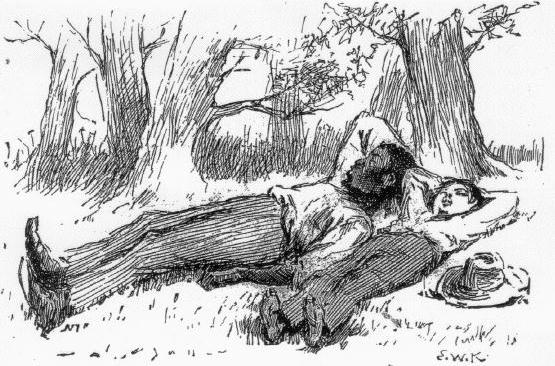
Getting a copy with the original illustrations is worth it.


3. All Other Literary Sins can be Forgiven if You’ve Read Huck Finn.

Let’s imagine that dinner parties were still things. What’s that, you say? Really? They are, huh? Weird.

OK, so let’s imagine that you’re at an actual dinner party, which is allegedly still a real occurrence. Somebody brings up Crime and Punishment, The Grapes of Wrath, The Great Gatsby, Pride and Prejudice, or one of the other few hundred novels that people wear like talismans around their necks once they get around to finishing them. You say, “You know, I’ve never actually read (insert classic here), but I read Huck Finn not too long ago, and it was fantastic; I don’t know how anyone’s ever called that a story for children." This accomplishes two vital goals: one, it immediately makes everyone around you forget that you haven’t read some other book whose title they can’t even recall at the moment, and two, it puts the pressure on everyone else listening to either ‘fess up to not having read this most seminal American work or find something very interesting across the room that they must attend to suddenly. Remember, they’re called the Culture Wars, and you need to win.


4. It’s Just So Much Fun

Let me get something out of the way: Huck Finn is not A Hitchhiker’s Guide to the Galaxy or even Slaughter-House Five. It is, however, better than both of those books and nearly as funny. But this isn’t about how funny the book is; it’s about how much fun the book is. Its cast of characters rivals (and probably trumps) anything Dickens ever put to the page, and its plot (don’t tell Twain you were looking for one) is simultaneously thrilling, frightening, hilarious, and suspenseful. For all the value I place on putting in the (sometimes difficult) work necessary to enjoy great art, Huck Finn, rich though it is, requires surprisingly little effort to enjoy. This doesn’t mean it’s simplistic, just that Twain so expertly executes his purpose that as you kick back on your porch (if you don’t have a porch on which to read Huck Finn, I suggest you engage in some minor trespassing, just to ensure the full effect), Twain’s wit and charm lift literary revelations right off the page and lay them at your feet, ready for your chewing pleasure.

Warning: If you attempt to read this novel on a summer evening while smoking a pipe, reclining near a body of water, or chewing on a stem of wild grass, you may collapse in a fit of sheer pleasure.


5. If Nothing Else...

- You need to know what all this n-word hubbub is about. That scoundrel from Auburn who’s aiming to censor Huck (and make a tidy profit from his own edition of the novel) deserves to be yelled at, but only by people who know why they’re yelling.

- It’s hundreds of pages shorter than other works that your friends have been pestering you to read. The $2.00 Dover Edition runs 220 pages, unabridged. 

- I nearly drowned a certain unnamed friend of mine in a certain famous river in a certain major British city because he admitted to never having read Huck Finn. Protect yourself from nut-jobs like me and read the damn book already.


By Josh Corman

Follow me on Twitter @JoshACorman

Wednesday, March 7, 2012

Five Easy Fixes for Your Everyday Bad Grammar

by Emily Walls

I've had a request for a little grammar workshop on the ol' Infusion. Obviously, I am going to fulfill this request because 1) grammar has only ever improved my social life and 2) someone talked to me! Because the breadth of the subject is so great, I have decided to limit this post to common errors and easy slip-ups. For a comprehensive study, see these:
  1. The Chicago Manual of Style: my style guide of choice, my dear companion, and my overdue library book
  2. The Grammar Girl: great online resource for your grammar queries
  3. The Elements of Style by Strunk and White: tips for everything having to do with writing; this book belongs on your shelf and in your glove compartment (for emergencies)
#5 It's its.

It's is a contraction of the words It is. Its is a possessive pronoun that means [blank] belongs to it. I know these two are tricky—really I do—but you can master them if you slow down while you're writing. Do this: mentally place a little red flag by each of the words. Are your little red flags waving? Excellent. From now on, you'll see your red flags waving whenever you write the words, and you'll stop to evaluate your usage. Here's our practice sentence:
"It's a beautiful day to burn down the enemy garrison," said the minotaur to its companion.
The first is a contraction of the words It is, so we use an apostrophe. The apostrophe basically says, "Hey, there used to be a space and an i here, but I beat the crap out of them and took their place."

Its, in the second part of the sentence, tells us that the companion belongs to the minotaur. Now, here's where our minds mess with us. We know that to make any noun possessive, we add 's to the end (e.g., my sister's bangs, my enemy's rotting corpse, my fish's sparkling personality). It is logical to us to do the same for it, but WE ARE WRONG. It is a pronoun (meaning a generic word used in place of a specific noun), and pronouns are tricky. Possessive pronouns do not use apostrophes. This is easy to remember with words like hers, his, and ours. Those look weird with apostrophes. If you saw "The house is our's" on a page, you would immediately see the problem. It might help you to remember that possessive its does not use an apostrophe if you can remember that its belongs in the same family as hers, his, and ours.

More than likely, however, you'll remember the contraction it's as a replacement for it is. Imagine the apostrophe as a militant terrorist who wants to exterminate all twenty-six letters of the alphabet. The apostrophe isn't strong enough to take out entire words, but it can assassinate a few letters at a time. If its campaign is successful and it murders letters A to Z, our future Verbal Infusion posts may become a bit...dull.
''''''''''''''''''''''''''''''''''''''''''''''''''''''''''''''''''''''''''''''''''''''''''''''''''''''''''''''''''''''''''''''''''''''''''''''''''''''''''''''''''''''''''''''''''''''''''''''''''''''''''''''''''''''''''''''''''''''''''''''''''''''''''''''''''''''''''''''''''''''''''''''''''''''''''''''''''''''''''''''''''''''''''''''''''''''''''''''''''''''''''''''''''''''''''''.
  
#4 Spell Definitely
Split it into three parts: de-finite-ly. Remember that your trouble with spelling definitely is not infinite; it is finite. If you can remember that the middle of the word is finite, then you won't be tempted to throw in a wayward a. Try it.

#3 Jonny and I took a picture. This is a picture of Jonny and me.
I'm going to be specific here because this is the error I see daily on Facebook.

Correct: This is a picture of Jonny and me.
Incorrect: This is a picture of Jonny and I.

Everybody knows the easiest way to work through it is to drop the other person's name and read the sentence with only the personal pronoun. This is a picture of I sounds absurd; therefore, it must be me. Bam. Problem solved.

But sometimes it sounds wrong both ways. Take this sentence:
Jonny and I are spicing up our marriage with a steamy read-through of the California driver's manual; it's not going well.
If you take out Jonny, it reads, "I are spicing" or "me are spicing." Both sound infantile, so you must look beyond the sound test for your answer. Ask yourself a few questions:

  1. Are you the subject of the sentence? In other words, are you the one doing the action?
  2. Is the action being done to you, not by you? (A dead giveaway is a preposition like of, to, or for before the pronoun.)
If you are doing the action, the correct pronoun is I. In our practice sentence, I am the one spicing up my marriage (i.e., doing the action), so I is the right word to use.

If the action is being done to you, the correct pronoun is me. For example:
A representative of the DMV issued a cease and desist to Jonny and me, demanding that we halt production of our highly anticipated marriage counseling book, Take Your Sex Drive into the Fast Lane.
Because the action (issued) is being done to me, not by me, the correct pronoun is me. To top it all off, the sentence also includes the preposition to, which is a great big flashing light that tells you me is the way to go.


#2 Then/Than
Then is used to give a measure of time. "We'll quash the Great Western Rebellion then. For now, let's drink."
Than is used for comparison. "Our benevolent new masters of the Great Western Rebellion are far more magnanimous than their humanoid predecessors."
If it helps, remember that then has an end and than has an and (as in, you're comparing this and that).

#1 Dangling Participles
A participle is an adjective that looks like a verb, and it usually ends in -ing or -ed. For (a completely fictional) example:
Panting with the effort of his sprint toward freedom, fifteen-year-old Steven congratulated himself on his victory over the Fuzz and his escape into the night.
Perturbed by their friend's easy getaway, Adam and Jonny immediately surrendered the name of their accomplice to their arresting officers.
Panting and Perturbed are participles that spearhead the participial phrases beginning both sentences. You'll notice that immediately following the phrases, the subjects of the participles are identified. Steven is panting; Adam and Jonny are perturbed. When a writer fails to identify the subject directly following the participial phrase, he creates a dangling participle, the bastard child of a capricious sentence.

Consider an alternative:
Perturbed by their friend's easy getaway, the arresting officers listened as Adam and Jonny surrendered the name of their accomplice.
See what I did there? I made it look like the arresting officers were perturbed, because I placed them directly after the introductory participial phrase. But why would they be perturbed? Their job is being done for them. THE SENTENCE MAKES NO SENSE. And that is the cry of every person who reads a dangling participle.

Don't dangle your participles in front of your readers. It's rude.

Thursday, March 1, 2012

Some Nights

By Josh Corman

Stealing titles is so much easier than inventing them!
Follow me on Twitter @JoshACorman

What I know:

I brought a bitter, windy cold with me to Grantham, Pennsylvania. As Ben, my friend of fifteen years, and I sat huddled on freezing metal chairs outside the Messiah College Student Union, I was reminded of Lewis Black’s rant about how much he hates the cold. You can’t even hold a thought in your head, he says (or shouts, really). Of course, the reminiscence, true to Black’s word, didn’t stick around for long.

Eventually, the powers that be opened the Union doors at about a quarter after seven. The six hundred of us who waited in line were ushered into the warmth, where we were handed rubber bracelets and directed towards the open area in front of a small stage, packed to its edges with guitars, horns, keyboards, and a drum kit. Ben and I planted ourselves in a space just a few feet from the stage’s right side (much, I’m sure, to the chagrin of anyone on that side of the room under six feet tall). Arms folded, backs straight, toes still numb, we endured an underwhelming opener (sample lyrics: Her name is Kendall/She’s an ordinary girl) as enterprising - and mostly female - college students jockeyed for position nearer the front. Then again, I’m not six-four and 230 pounds for nothing. We weathered the siege, the openers left the stage, and the massive clock hanging on a wall left of the stage ticked on. Its second hand may as well have been a barometer, spinning like Clark Griswold’s electric meter on Christmas Eve. With each one of its short jumps, the room grew warmer, nervier, more volatile.

The lights dimmed. Eyes turned to the closed off balcony behind us where four men and a red-headed whisper walked in a single file, all smiling as they took a staircase down to ground level, behind a lengthy divider, and strolled onstage.

Over tinkling piano, Fun.’s (for legal reasons, always spelled with that period at the end) lead singer, Nate Ruess, sang to the hushed throng: “Some nights, I hold to every note I ever wrote/Some nights, I say, ‘fuck it all,’ stare at the calendar/Waiting for catastrophes, imagining they’d scare me into changing whatever it is I’m changing into.” He raised his eyes then and almost hissed, “You have every right to be scared.”

And just like that, Nate Ruess held six hundred people in his sweating palm. About an hour later, he had every voice singing with his the chorus to Fun.’s wildly popular (top of both Amazon’s and iTunes’ mp3 downloads) song, “We Are Young.” From what I could tell, nearly everyone in the room knew every word. The album had been out for four days.

At some point near the show’s end, Nate thanked the crowd. It was the first show of the tour, he told us, and “...this is just-” but he didn’t seem able to find the words.

What I think:

I think that in less than twelve months time, Fun. will have played Saturday Night Live.

I think that “We are Young” will win the award for best song at next year’s Grammys.

I think that the work that Fun. is doing (and that Ruess’ old band, The Format, did before them) is as good as any music I’ve heard in the last decade.

I think that I saw a band on the brink of stardom.

I think that when Nate Ruess stopped short as he addressed the crowd at Messiah College, it was because in that moment, but not before, he thought all of this too.

The new record, Some Nights, is largely a record about duality. Its opening lines (the same which opened the show) hint at as much. Some nights we want to be held, some nights we can imagine only being alone. Some nights every choice works out, some nights we can make only mistakes. Some nights we know what we’re doing, some nights we haven’t a clue.

None of this is groundbreaking territory, as far as rock musicians go. But the duality which Fun. examines most closely is a rarer bird. Go back and look at those opening lyrics. Some nights I believe in my vocation, my art, and essentially myself, some nights I look for any excuse I can find to rid myself of the burden that being an artist has put on me. How much longer, he asks, can I reasonably do this before I hang it up? Will there come a time when six hundred people in a college Student Union will mean defeat rather than success. Has that time already come?

The songs on Some Nights ask these questions again and again. Ruess sounds, for all the world, like a man giving professional musicianship one last run, to see if it’ll finally stick.

I think that he got his answer last Saturday night.

What I Believe:

I believe I’ve got some talent as a writer. I also believe that talent is only a small part of success in any given field (just think about how often we see it easily squandered). After Ben and I left the show, I wondered about those very same dualities Ruess wrestles with in his lyrics. Any writer will tell you that on some days when you stop working you feel so good about what you’ve created that you’d challenge Hemingway to a duel, fifteen paces at dawn. Other days, you feel like you’re a shame to Stephanie Meyer’s profession (cheap shot, I know, but I’m working out some demons here). It’s just the nature of the artistic beast.

I read somewhere the other day that writing is awful, but having written is wonderful. That is perfectly true. For about five days. Then the dreaded "other side" of a writer’s life rears its head. Query letters, rejections, agents (or worse, the lack thereof), publishers (see last parenthetical), and the prospect of each day waking up to write words that no audience might ever read are so much more daunting than deciding whether or not the third paragraph on page thirty-eight really needs that last sentence.

There’s a great line in High Fidelity where Rob (John Cusack’s character) says in voiceover, “Only people of a certain disposition are frightened of being alone for the rest of their lives at the age of twenty-six. We were of that disposition.” I feel like, if modified slightly, those lines would describe me only too well. Only writers of a certain disposition are frightened of remaining unnoticed for the rest of their lives at the age of twenty-six. I am of that disposition.

This is, admittedly, not a good sign. Tons of great writers don’t have any notable publishing success until they’re in their forties. Twelve houses passed on Harry Potter. A half-dozen record labels passed on The Beatles. So what happens when (the word “if” would be absurdly naive) months or perhaps years have passed and I’m essentially right where I am now. Am I prepared to stay committed? To trust that as long as I put in the work on my end that some form of validation will arrive? Will I have the guts to keep pushing myself like Nate Ruess has done?

Some nights I believe I can do it, but some nights I just don’t know.

By Josh Corman

Follow me on Twitter @JoshACorman

P.S. - Do yourself a favor and give Fun. a listen here.

Tuesday, February 28, 2012

Six Principles That Guarantee a Remarkably Tolerable Marriage

By Emily Walls

A good marriage is like a fine wine: It smells of rot and is inherently alcoholic. After more than thirty months of marriage and twice as many boxes of cabernet, I should know. Many said that I was too "emotionally stunted" or "unstable" or "I beg of you, please put down the dagger" for marriage, but Jonny took a chance on me, and I, in turn, took a chance on 1.3 European cut carats. I truly believe we were made for each other.

And we'll be together forever.

And so, in my beneficence, I offer these principles for a healthy marriage. May they guide you toward the wedded euphoria in which we bask and toward which you may vainly strive.


Principle #1. Communication: Poison in the Marriage Well

"We need to talk."
Right behind "How about sex tonight?" those are the scariest four words your spouse can utter. An unexpressed thought is a dollar in the mind bank. You wouldn't give away all (or any) of your real dollars, would you? So why would you give away your mind money? Your spouse is already a drain on so many areas of your life; let your thoughts be yours alone. You can save your spouse and yourself a lifetime of awkward conversation and imprecise analysis with a lifelong dip in the golden pool of silence. I can't tell you how many times Jonny has come to me and said, "Emily, it hurts me when you call me ______" or "I could use a hug" or "I may have just killed a prostitute," and for both our sakes, I have had to stop him from continuing. Not only does conversation ruin the feng shui of the marriage relationship, but also it limits the imagination. It's so much more interesting and exciting to guess what the other is thinking. And guesswork and imagination are the bedrocks of...


Principle #2. Sweatpants: The Lingerie of the Enlightened

When I get home from work, it takes me maybe thirty seconds to change into my boudoir attire: fifteen-year-old, ripped, flannel, size XL men's pajama pants. For his part, Jonny doesn't leave the house in anything but sweatpants, if he bothers to put on pants at all. We have discovered the passion and desire that baggy jersey knits can incite. Because this is a family site—and by that I mean our immediate family members are our only readers—I will not go into further detail about our raging libidos. Let's just say that the other day I saw Jonny in gray terrycloth bottoms, and for one crazy moment, I considered giving him a closed-mouth kiss. It was wild! Strictly adhering to Principle #1, I, of course, did not express the thought to Jonny. Nevertheless, I fully embrace the titillating merits of sweatpants, and I pity those who are stuck in prisons of lace and satin. Naturally, I also pity those who don't yet know...


Principle #3. Grooming, like Sex, Is Optional

Back in elementary school, my parents told me to brush and floss my teeth, but you know what, Mom and Dad? Those teeth fell out. Luckily, new teeth grew in to replace their fallen comrades, but I'll never again be duped into spending five more minutes of my day on hygiene. I have enough trouble squeezing back-to-back marathons of Pawn Stars and Storage Wars into my precious eight hours of awake time. When Jonny turns to me at night and gives me an air five from his twin bed across the room, I know he's really saying, "May I braid your leg hair sometime?" That's a special bond between a husband and wife. Regular grooming will only sterilize your relationship, and while reproductive sterility might be a good option for you (it was for us!), metaphorical sterility will bleach your relationship of its vibrance.


Principle #4. Sharing: The Great Divider

Before you and your spouse go merging your books and movies and ideals into a giant marriage liabilibrary, consider for a moment the unsung virtues of selfishness and violent individualism. Sure, you could let him read your Bible when he leaves his in the other room, but wouldn't that just go against the Teaching a man to fish, Place for everything and everything in its place, When life gives you lemons make lemonade stuff that Jesus preached about (Jude 5:8-23)? When you share with your spouse, you are enabling his laziness. Let him bring his own TV, his own couch, his own meals, his own bed (and if not, floor), his own ovaries into the relationship. You'll see a drastic improvement in self-morale when your things are your things alone. I will caution, too, that chores should never be shared. You must not take from your spouse the joy of cleaning.


Principle #5. "Dear," "Baby," and "Love": Four-Letter Words That Will Ruin Your Tolerate-Life

Far too often, I hear young couples using so-called "pet names" with each other, and I have to shake my head in grief. First, they are addressing each other, which directly violates Principle #1. Second, if they insist on disregarding my sound advice, they can at least inject a bit of individuality into their rhetoric. Consider the following pet names that Jonny has given me in the last week. Although I cannot yet convince him to embrace Principle #1, I have to applaud his eloquence. He has called me:
  • my precious little fruit cup
  • my half-eaten McGriddle
  • my tin of parrot food
  • my sweet little card catalog entry
  • my wire-mesh soup strainer
  • my favorite ball of yarn
Any woman would melt at such tender expressions, which proves that I am not just any woman (or a woman at all, for that matter).


Principle #6.  Erotic Parcheesi

Trust me.


By Emily Walls

Friday, February 24, 2012

Five Things about Today's World That Would Have Shocked Me in High School

By Jonny Walls

If my hairline has taught me anything (and I think it has), it's that a lot can change in ten years. But there are certain things that are currently true about this world that would have shocked me to have known when I was in high school. Be assured, I don't consider these the five MOST shocking things that have come to be true in the world since I was in high school (in some cases, they are far from it), they are just some shocking things that have come to be true.

5. The Death of Steve Irwin

One may be tempted to call Steve's heartbreaking demise less than shocking, as the man mixed it up with gnarled crocodiles and tangoed with venomous snakes for a living. But the blindness of human perception, at least for me, created a falsely secure view of Steve, not unlike something out of Hollywood. Watching Steve was like watching Indiana Jones: we allowed ourselves to be caught up in the danger of it all, but we never believed anything could really hurt him. When it happened, it rode on a sobering wave of reality that never quite seemed true.

4. The Cell Phone > Flip Phone > Razr > Blackberry > iPhone "Evolution" (Read: Takeover of Society)

When I graduated from high school, I had one close friend who owned a cell phone. One. And he didn't bring it to school or carry it around with him. It hardly ever left his vehicle, actually. I knew a few parents who had had one for a few years, and I had a few other acquaintances with cell phones, but my existence was, for all intents and purposes, a cell phone-less existence. Five years later, more or less everyone I knew owned a cell phone. Now, just over ten years later, its market saturation is complete. I suppose if I had really sat down and thought about it, I would have seen this coming. The evolution of technology is inevitable and the cell phone revolution was poised for dominance at the turn of the century, but in my world, phone communication had always been locked within the parameters of our homes. Voice messages waited patiently at home for me to come receive them. The notion of being always available, not to mention the subsequent and immediate frustration that now sets in when someone is unavailable, would have shocked me.

3. Internet on the Go

This is in a similar vein to the last one, but it is distinctive enough for its own slot. Remember, technologically behind the times as I may have been, I was a "normal" breed of behind the times, the last 33% of society to the party, not an anomaly. The internet was still a rather gimmicky thing when I was in high school. My personal experience had been confined to AOL email, instant messaging, and chat rooms until my junior year, when I first learned how to use a search engine. That notion would have seemed laughable to juniors five years ago, let alone today. The idea of having the internet—this strange, unidentifiable being that came in through the phone wires—in the palm of my hand wherever I went would have downright staggered me. The change has been gradual (although less so than past technological changes), and so the dramatic shift in the way society behaves has crept up somewhat unnoticed. If I had jumped straight from my last...er..."class" senior year to today, and gone to a typical party or social gathering where the majority of eyes were locked in the down position, toward the little glowing screens in front of them, and seen the way we instinctively, even desperately depend on the constant flow of information that they provide, I would have been shocked. The spaceship scenes from Wall-E don't seem so far fetched all of a sudden.

2.  The Death of Saddam Hussein

Again, maybe this seems like something that was bound to happen and therefore unworthy of the "shocking" moniker, but once again the phenomenon of human perception disagrees. Saddam Hussein's name became vilified to the point of legend early in my elementary school days, with the result that I never thought of him as an actual human. He was a myth, a cloud of evil that would always be around. When he became a flat out wanted man, it was always assumed that the chase for him would continue, that he would always be The United States' Shredder: even a trash compactor couldn't kill him. But, like the death of Steve Irwin, although in starkly different circumstances and summoning starkly different emotions, a sobering wave of reality accompanied Saddam's death and reminded us that we're all human, we're all vulnerable. A world without Saddam Hussein was hard to wrap one's mind around, and then just like that, he was gone.

1. The Loss of Pluto

Look, if there is one thing every third grader from the last 300-odd years has known beyond a shadow of a doubt, it's that our Solar System has nine planets. It is one of the elementary mind's great axioms:

2 + 2= 4

E=MC2

George Washington was the first president of the USA.  

The Solar System has NINE freaking planets!

And then science, that unfeeling, analytical monster whose very heart is as cold and unyielding as the icy block of a former planet which it so callously demoted, took it away. Kids, don't believe everything your teachers tell you. It's only a matter of time until it's proven wrong.
Then again, maybe I'm overreacting. Without science, we wouldn't have knowledge of such simultaneously enchanting and educating phenomena as Alchemy, Craniology, and of course, everyone's favorite monsters of yesteryear, the dinosaurs. Yep, I'll always have my dinosaurs, and my beloved personal favorite, the Triceratops...

By Jonny Walls

Wednesday, February 22, 2012

The Destructor: An Open Letter to Malcolm Gladwell

By Josh Corman

Pictured: Smug Bastard
Follow me on Twitter @JoshACorman

Dear Mr. Gladwell,

Curse you. And that’s just for starters.

Your books have made me seriously reconsider what I know and think about the world around me, and, frankly, I feel violated. Have you any idea just how long I strolled about my day to day life, absolutely self-assured and totally confident that I knew everything worth knowing? A long damn time, sir.

I knew how to fill out an NCAA Tournament bracket, how to parent, and how to bluster knowingly in the directions of intensely bored friends about crime, education, business, and politics. But that’s all crumbled now, thanks to you. Now I bluster about the things you think.

If you suspect that I am somewhat to blame for the sad state I find myself in, that I simply could at any time stop reading your books and your New Yorker articles and the interviews you do and thus spare myself the indignity of being shown up as someone who understands very little (but proclaims to know quite a lot) about the world around me, then I take offense at that typically arrogant insinuation. How can I stop? You see, only by continually investigating your “well-researched” and “insightful” works will I ever find the critical mistake, the half-baked error that will invalidate all of your “wise” and “transformative” and “mind-bendingly revealing” drivel. Yes, I must soldier on.

Or so my thinking went.

One day last week, I pulled up a video of a speech you had given at a TED conference in 2004. I was searching for a short but rhetorically effective display of deductive reasoning to show my AP Language and Composition classes, and, in my poor judgment, I played your “Spaghetti Sauce” speech for my unsuspecting students. While they were largely unaffected (the coming generation has thankfully been immunized against exercising their capacity for abstract thought in all but the direst circumstances), I was once again traumatized and affronted.

In that speech, when you summarize the work of Howard Moskowitz , you extol the virtues of “horizontal segmentation,” wherein the largest possible number of people have the greatest chance at happiness when they abandon the Platonic ideal of one perfect choice. Instead, you suggest that they embrace the idea that no spaghetti sauce or mustard or olive oil is intrinsically better than any other, only that there are sauces and mustards and olive oils better suited to their individual tastes. I then (as I assume was your nefarious goal all along) applied this logic to my own choices.

Traumatized and affronted, sir. Traumatized and affronted.

Of all the other deeply held convictions you have made me question, none has horrified me so completely as this. I have impeccable taste. That taste is rooted in years of placing every conceivable song, film, book, album, score, and short story into a painfully crafted hierarchy of perfection. And from the top of that hierarchy I looked down at Stephanie Meyer and Nickelback and Drew Barrymore and I laughed, sir. Sometimes in pity, sometimes in rage, but always from the safety of my ivory tower.

Your implied suggestion that, in fact, relentlessly mocking Twilight and Two and a Half Men and Michael Bay’s films is not a beneficial and worthy use of my time, and that I should instead simply recognize that the people who enjoy things that I dislike are not actually brainless slugs whose very existence signals the apocalypse’s imminence appalls me. What else am I supposed to do with my time?

I have spent hundreds of fruitless hours in circular debates in which nothing is concluded but the friendships of those involved. If you claim that these have been a waste, you call into question my intellect, my behavior, perhaps even my sanity.

I’ve spent much of my life making sure that I am right, but now, all of a sudden, I wonder whether or not I actually am. Or if it's even possible to be "right" when it comes to matters of taste.

How dare you.

By Josh Corman

Follow me on Twitter @JoshACorman

P.S. - To better prepare your defenses against Malcolm Gladwell's devilish schemes, watch his "Spaghetti Sauce" speech.