Friday, January 13, 2012

Real Life Series: Don't Drink it 'Til it's Black Edition, Excerpt Two

Here you are, folks: a hot buttered serving of the (hopefully) forthcoming memoir from me and Jonny Walls. As with Jonny's excerpt, this picks up right in the middle of a much, much longer tale (and is not a continuation of his previously posted section). This section, narrated by yours truly, finds our weary heroes ascending Goatfell, a mountain on the coast of a Scottish isle.

Follow me on Twitter @JoshACorman (if you're a literary agent, may I say that you're quite intelligent and good-looking and have impeccable taste in shoes)

By Josh Corman

It isn't long before we notice the steady stream of people walking in the opposite direction. Almost every one of them is replete with elaborate hiking gear: walking sticks, heavy coats, sunglasses, and hiking boots.

"I suddenly feel very under-prepared." I say, "These people look like they're returning from the summit of Everest.

"It can’t be that bad. We'll follow the trail as far as we can. Let's get out of these trees and see what it looks like."

I keep quiet and stay a few paces behind Jonny, taking the occasional slug from my water bottle. Soon we emerge from the lowest part of the trail and the landscape opens up completely. A good distance beyond the edge of the trees, I stop and step off of the trail toward a small stream.

"Too tired to go on, eh?"

"Just refilling my water bottle."

"What? Just in the stream there? You're just going to drink water form some stream?" Jonny, it's safe to say, has an issue with germs. He would say he has a healthy respect for them, and it's true. But at times it goes beyond that. Once, after fixing tea at his house, I tapped the handle of a tea strainer on the sink to knock off excess water after washing it, and after I put the strainer on the dish rack, he picked it up and washed it off again before putting it in the drawer. I love to give him a hard time about it, even though I'm the one who will probably die of some infection because I don't wash my hands before every meal.

I dip my bottle into the flow and withdraw it, filled  to the top with cold, glistening water. For good measure, I hold the bottle up to the light and admire its clarity. (Spare me the lecture, science-folk. I know bacteria are microscopic, but it’s as clear as could be, not even a speck of refuse.)

"There isn't anything above us on the mountain, no runoff from anything but snow and rain. If I was drinking from a fetid, stagnant pool of brown water, I'd worry, but I'm thirsty." As I lift the bottle to my lips, Jonny recoils, as if I'm about to pour a vial of hemlock down my throat. I gulp down nearly half the bottle and stoop to refill it. "It's delicious. Best water I've ever had, literally." I’m laying it on a little thick, but the water is cold and quenching. When I extend the bottle to Jonny, he declines.

The traffic heading back down the mountain remains heavy for another twenty minutes. It makes me a little nervous to see all of these people (several of whom shoot us puzzled looks as they pass), who so clearly know what they're doing, getting out of Dodge while we amateurs march on. But march on we do. We reach a point where the incline becomes even steeper and the ground is dotted with rocks the size of medicine balls and larger. The previous days' travel catches up with me all at once, and I grab a seat on one of the rocks while Jonny strays from the path, attracted by a small waterfall about a hundred yards to our left. The weather has changed and a thick mist clings to the mountaintop and hides the sun. I'm reminded of Emyn Muil from The Lord of the Rings and find it easy to see how Tolkien used Britain's landscapes to paint Middle-Earth in true colors. The wind gusts and howls and long brown grasses sway in rhythmic union and even though I'm tired and cold, I know that I've never seen anything quite like this. When Jonny returns, he wears a smile, and I'm glad he's here to force me along.

The trail soon peters out almost entirely and my exhaustion tells me that this would be a fine place to stop, turn around, and proceed to the sustenance of a hearty meal and the warmth of Brodick House.

A friend is supposed to support you, but he is also supposed to do what's best for you, not only what is pleasant. Jonny notices the similarities to Tolkien's world as well, and he keeps the conversation in that line, presumably to take my mind off of just how tired I really am. I see right through it but don't have the energy to protest. "Come on," Jonny says. "Let's get up there to that ridge just under the peak. We won't be able to get any higher than that, but that ridge looks out over everything. We can at least say we made it that far."

I stumble on, but soon we’re stopping every hundred yards or so because of me.

"Corman, pretend there are Orcs on your trail. Just a little farther." Jonny, it turns out, makes quite the Samwise Gamgee. I stand, and instead of traipsing past a few dozen more rocks and sitting again to catch my breath, I am possessed by the utterly foolish notion that if I sprint as fast and hard as I can over the brittle, uneven terrain, I'll make it to our stopping point in one go and then we can simply turn around and fall back to the base of the damned mountain. So I run. I hurtle rocks and cut like a running back into open spaces and up, farther and farther, until the ridge is right in front of me. The ridge itself ends in a cliff face that plunges seventy-five degrees towards the sea below and runs parallel with the coast that extends from the beach across from Mike and Nan's house all the way around the island. From our point on the ridge, the peak of Goatfell rises sharply to our left, blocking out any view of the far side of the island. I nearly collapse onto a rock at a spot perhaps six hundred feet from the summit.

Moments later Jonny is beside me, though I don't really remember him getting there, and I momentarily wonder if I blacked out. The mist is heavy as rain, and my puny cotton zip-up hoodie is rapidly absorbing moisture. My hair is soaked, my shoes are soaked, my jeans are clinging to my legs, and like a child I wipe my running nose on my sleeve. When I finally look up and out over the water, the seeming incongruity of the view is alarming. To the right, the entirety of Arran Isle is laid out before us. Sheep graze in their pastures. Hills and farmland beyond the coast roll and merge with dense forest. Taxis and tiny cars cruise the narrow road just off the beach and inward away from the water. The shadows and mist that have engulfed us do not touch what lies below. Sunlight covers everything we can see, and in the distance we can even glimpse the mainland, kept at bay by the sea.

"This is unbelievable," I manage.

"Look at the difference," Jonny muses. "Behind us it looks like Mordor's doorstep, but out here it's perfect."

I stand and walk nearer to the edge, surveying the world in front of me as though it wouldn't be there if I closed my eyes and opened them again. "You know what," I say. "This is simultaneously the worst and the coolest thing I've ever done."

Jonny laughs at me, but it's the truth. I could have stayed down at the bottom of the mountain and drunk tea, and it would have been fine. I could have stopped half-way up the mountain, seen the peak, and gone back without feeling like I had missed all that much. It would have felt fine, but that's it. It would not have actually been fine, because I would have short-changed myself, all because climbing a mountain is hard.

Damn straight it's hard. But if it weren't as hard, then the view wouldn't be half as sweet. And honestly, the only thing that ends up making any difference is how sweet the view is.


By Josh Corman

Wednesday, January 11, 2012

Real Life Series: Don't Drink It 'Til It's Black Edition

Excerpt From a Book by Josh Corman and Jonny Walls. This Section by Jonny Walls

A few important words about this post. The following is an excerpt from Don't Drink It 'Til It's Black, the (in development) true memoir of Josh Corman's and my 2007 trip to Britain. The memoir is co-written by the two of us. Roughly half is written by me, in my first person voice, the other half by Josh, in his voice.

Unlike past Real Life Series entries, what you are about to read is not, in any way, a fully formed short story with a clear beginning, middle, and end. This is an excerpt lifted straight out of the middle of a larger story. Also, it should be noted that, as of the time of this writing, we are still on the second draft of the memoir, and further polishing and improving may occur to all sections presented here.

This section of the story finds Corman and me on a bus, racing up the coast of Scotland. We've just gotten off a ferry which brought us over from Ireland. The ferry was late arriving, causing all passengers to miss a train that had been waiting for us. So, the company that owns the ferry has called in an emergency bus to take us all up the coast to a different train station where we can hopefully catch trains to our various destinations before they stop making runs for the night.

Look for another random DDITIB excerpt from Corman on Friday. Enjoy.  

Excerpt from Don't Drink It 'Til It's Black


In a matter of minutes we’re lumbering our way up the coast via a precariously high and thin road. More fields of devastating green stretch out to our right, illuminated in patches by the waning sunlight bursting through an occasional hole in the clouds. On the left the coast swings in and out of sight, terribly striking, and a good 150 feet down the cliffs we so speedily traverse.

I’m beginning to feel a Richie-like fear when another phenomenon commands my attention. I realize all at once that we’re embroiled in a classic, childhood, school bus situation. Corman and I, along with a number of other mild mannered or elderly groups, are huddled in the first few rows of the bus. We’re the Good Kids. The back, however, is under the reign of the Bad Kids. The difference now is that they aren’t throwing raisins out the window or rolling apples up the aisle or even puncturing holes in the upholstery seats. They’re piss drunk. All of them. Evidently the boat ride over from Ireland was more of a party cruise for this bunch than the pragmatic mode of transportation it was for the rest of us. Soon, the general revelry is spilling out of their private party in the back and being directed at the front of the bus.

“Hey, driver! We need some more booze back here!”

“Ruddy’ right Charlie! Driver, there was booze on that boat! Why aint’ you got any for us, eh?”

They seem good-natured enough for all of their loud mouthed carousing, but I strongly hope they don’t find any reason to yell at the guy up front in the Notre Dame hoodie. Slightly amused and more than a tad uncomfortable, I force myself to continue enjoying the splendid passing scenery.

Moments later someone hurriedly brushes my arm. I glance up to see Charlie or some other sloppy drunk from the back making his way to the driver carrying what looks like a chili sack lunch without the bowl.

“Driver, my friend gone ‘n hurled in this bag. Where should I put it?”

To my amazement, the driver, who has held a respectable level of stoicism up to this point, straight up stonewalls the drunk. Glances are exchanged among us good kids, all wondering the same thing. How will this play out?

"Driver, didn't you hear me? I've got this vomit here, and the lads all have to piss."

The driver keeps his eyes on the road and doesn't say a word as if this is all business as usual. Hell, maybe this is business as usual. Maybe, like the cheeseburger joint owner in Dublin, this is just another Sunday afternoon in the Scottish bus driving world. Maybe there’s a training program for these guys. I can hear the instructor in my mind, straight out of Full Metal Jacket: “You WILL encounter drunk men on the job. LOTS of them. You must ignore them. You will make them think they don’t exist. Hell, they DON’T exist! That is the ONLY way to deal with a drunk Scotsman!

His speech is followed by a rigorous training course where inexperienced, soft willed drivers are subjected to the worst drunken taunts imaginable while operating a bus-driving simulator. Only the strongest survive the full course, and none go without at least one lapse into tears. This man before me was clearly the best in class.

The drunk turns unsurely back to his seat, barf bag in hand. Our heroic driver’s eyes flit to the left for only the scantest of split seconds, and I know that I’ve witnessed a master at work. A true genius. This man is unflappable. We are on a course to make up lost time, to get a bus full of eager tourists to a train in the small town of Ayr to make up for his company’s late boat. This is the hour he has been training for. He drives for us, the good kids. He drives for honor. And nothing can derail that. Ignoring a chorus of cries from the back, he drives on.

Ten minutes later the bus is on the side of the road and a line of fifteen shit-faced Scotsmen pee into the bushes. The sight is amusing, but I’m forced to shelf the hope that I’m in the care of one of the last true heroes on the bus-driving circuit. Yes, every man has his price, or his limit, as it were, and fifteen drunken Scotsmen begging for a roadside pee-break proved more than our fallen hero could withstand. My shameless optimism has let me down this time. We roll on a few minutes later, and I go north a wiser man.

Excerpt From a Book by Josh Corman and Jonny Walls. This Section by Jonny Walls

Thursday, January 5, 2012

Death of the Cool: A Defense of Cameron Crowe

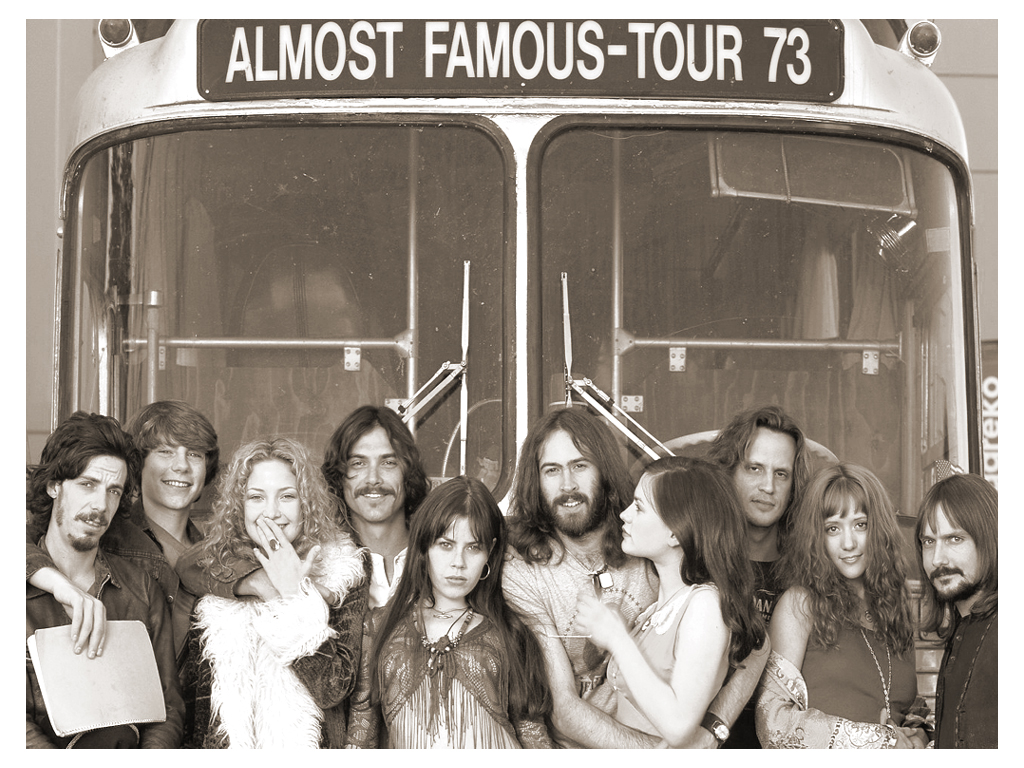
One of these things is not like the others.
Follow me on Twitter @JoshACorman

By Josh Corman 

I once tried to write about Cameron Crowe.

What I Wish Had Happened: I poured myself a drink, brought a stack of records to the desk, threw on side one of Bruce Springsteen’s Darkness on the Edge of Town, cracked my knuckles, and typed without stopping (except to flip the record or raise my glass, of course) on my Smith-Corona Galaxie XII typewriter until I had produced nearly 2,000 flawless words about a man in whom I am very much interested, the venerable Mr. Cameron Crowe. 

You see, if I were writing about Cameron Crowe, I would have to get myself into a Cameron Crowe state of mind (or so the logic went). 

What Really Happened: I curled up in my bed, secluded (the better to concentrate, I told myself), intent on writing about Cameron Crowe. No drink, no vinyl, no typewriter. There may have been 2,000 words somewhere along the line, but most of them are deleted. Three or four different false starts later, I finally scrapped the piece and rescued something from my “works in progress” folder and shaped it up for a residence on this site. 

What’s Happening Now: More than a month later, I sit at my desk, having at it one more time. Drink: yes. Records: no (iTunes will have to do). Typewriter: Never even owned one. Cameron Crowe: Finally, yes. 


“The only true currency in this bankrupt world is what you share with somebody when you are uncool.”

Go ahead, read it again.

One more time. Seriously.

If you’ve got guts, read it aloud.

I’ll give you a minute.

...

Let me just tell you that there are some things I wish that I’d written. As far as single sentences go, that one is at the top of my list. The profound sense of envy I feel about not having written that line is compounded by my even more profound envy I have towards the person who actually did write it. You guessed it: Cameron Crowe.

The bastard.

The line, delivered by Philip Seymour Hoffman’s note-perfect Lester Bangs, comes from Crowe’s magnum opus, Almost Famous, which loosely recreates Crowe’s teenage years when he scored a job writing for Rolling Stone and toured the country with The Allman Brothers’ Band, Led Zeppelin, Neil Young, and The Who. OK, so envy doesn’t adequately describe the feeling. I actually feel wronged by Cameron Crowe, like he’s cheated me out of experiences that I might have, nay, should have gloriously lived out if I had been a fifteen-year-old prodigy in Southern California in 1973. I should hate the guy, right? I should find his films insufferable or pretentious. The schadenfreude potential is enormous, folks.

But I actually kind of love him.

And it isn’t that Crowe is a particularly great director. He’s good, certainly. He’s got a (usually) deft ear for clever dialogue (Lloyd Dobler’s career speech in Say Anything; most of Jerry Maguire and Almost Famous), he’s crafted his share of memorable moments (Say Anything’s so-iconic-as-to-have-suffered-the-unjust-fate-of-becoming-overrated “boombox scene,” the “You had me at hello” and “Show me the money!” scenes from Jerry Maguire, the “Tiny Dancer” scene from Almost Famous) and characters (Dobler; Maguire, nearly everyone in Almost Famous), and he’s got a bold streak to boot (Vanilla Sky).

Despite this respectable accumulation of artistic achievement, Crowe routinely falls short of greatness. His movies are almost always too long, the plots are frequently circuitous to the point of distraction (even his masterpiece is guilty, though I’m charmed rather than annoyed by it in that case), and he’s drawn stilted performances from his lead actors on more than one occasion (Renee Zellweger in Maguire, Orlando Bloom in Elizabethtown). Even his oft-praised encyclopedic knowledge of—and deep-seated love for—pop music has grown into as much of a crutch as a weapon.

So he’s what, a middle-aged director with a huge stack of vinyls who charts at the high end of average and who only puts out slightly more than two films a decade?

Well, no. Not quite. That is, he may be those things, but he also possesses at least one other salient quality that keeps me from dismissing the guy as a one and two-halves hit wonder as some of the “serious” film-going world has. The best illustration of this particular quality is Crowe’s much-maligned (as in, the professional and amateur film critics of the world got together and voted to enact a social mandate threatening a public flogging to anyone who expressed genuine appreciation for this film; see M. Night Shyamalan’s The Village) 2005 pet project, Elizabethtown.

The movie tells the story of a prodigal son’s journey (warning!) to retrieve his father’s body (repeat: warning!). On the way, he meets a quirky flight attendant (WARNING!) who opens his eyes (For the love of God, somebody do SOMETHING!) to the spirit of adventure and empathy (CRASH!), and leads him via mix-tape on a cross-country journey of self-discovery. (That sound you hear is the orchestra still playing as the icy water slowly fills the ruptured hull of the Titanic.) Elizabethtown is, by any measure, an act of self-indulgent directorial gluttony. I should hate this movie, just like most people do.

But I actually kind of love it.

That quality of Crowe’s I mentioned earlier can best be described as a painfully earnest desire to get to the root of what makes us afraid of the world around us, and it positively drips from Elizabethtown. Orlando Bloom’s character (Drew Baylor) is emotionally able to go on his film-ending road trip only after suffering a spectacular, career-ending failure, being harassed by his family into realizing that he barely knew his father, and having all of his sophisticated affectations exposed by a series of people who challenge the one thing he clings to most fiercely: his coolness. There, I suspect, lies some of the explanation for the vitriol surrounding Elizabethtown. We see movies where a loss of cool is necessary for a character’s self-realization as trite and cheesy. As the parent of a two-year-old, I can vouch for the stunning number of children’s movies in which this same general character arc is present.

If the connection seems flippant, I’m sorry. It isn’t meant to be. We associate the themes Crowe so often explores as childish and unworthy of serious adult consideration, especially when they’re explored as un-ironically as Crowe does in his films. I say films because when I think about it, every film of his that I’ve seen (all but Singles and the newly released We Bought a Zoo) features a character who is stripped of his cool on his way to the tale’s climax. In Say Anything, it’s Dianne (Ione Skye’s character) whose Class President sheen is stripped away as she fumbles her way through normal social experiences and her relationship with her father crumbles. Jerry Maguire falls from grace and is rescued from professional and relational hell only after making a fool of himself on a grand scale and realizing that he isn’t too good for his wife. Both Penny and Russell in Almost Famous are nearly reduced to rubble before their epiphanies arrive. Even in Vanilla Sky, a film he didn't write, David Aames is brought low from his days as an invincible playboy by a relationship he plays a little too coolly.

Why does any of this matter? How does it make Cameron Crowe anything more than a mediocre director who’s a total sap on top of everything else? It matters because I hold a special place in my heart for people who really, violently mean what they say, even when what they say is on the hokey side. It’s the same reason I love Bob Dylan and Neil Young despite the considerable gap between their artistic ambition and the quality of their voices. They mean what they sing so intensely that their depth of feeling overcomes flaws that seem more and more inconsequential the more you listen to their music.

If Dylan and Neil were cool, they would never have opened their mouths. If Lloyd Dobler were cool he would have never blasted “In Your Eyes” from that boom box to a girl who’d broken his heart. If Jerry McGuire were cool, he never would have saved his marriage. Russell Hammond wouldn’t have given William that final interview. Drew Baylor never would’ve truly appreciated his father. These people can't be saved as long as they're cool. Cameron Crowe believes fundamentally that coolness is a false currency, a shield that we use to protect ourselves from the most frightening, vital aspects of the world around us, and he can’t help but show us how fervently he believes it, over and over again. You know why? 


Because Cameron Crowe is uncool.

By Josh Corman

Follow me on Twitter @JoshACorman

Friday, December 30, 2011

Short Hiatus

Verbalinfusion will be on a short hiatus until January 5th or possibly 7th. Thanks for your patience and see you all in 2012!

-Jonny and Emily

Sunday, December 25, 2011

She Sees You When You're Sleeping

Merry Christmas to all! I have a very special gift for you on this very special day: a video of me the day after I lost my two front teeth.


I can't decide which facet takes the Awkward Factor to 11 in this video, but I've narrowed the field down to three, or possibly four, contenders.
  1. Debilitating perfectionism manifested in a six-year-old (0:00-0:30)
  2. A narrow focus on inane fact vs. a broader understanding of global context, suggesting grossly underdeveloped cognitive and social skills (0:38-0:44)
  3. Portents of sociopathy (1:00)
  4. The bangs (1985-1991)
You decide.

Have a wonderful and blessed Christmas!

Emily (and Jonny)

Friday, December 23, 2011

My Greatest Christmas Ever

By Jonny Walls

Generic Christmas Related Photograph

It was Christmas day. I was five, maybe six years old. All I wanted was a remote controlled car. That's all I had wanted for at least a year running. I had asked Santa. I had asked my parents. I had asked aunts, uncles, anyone who would listen. I was the Ralphie of the remote controlled car scene. I know they weren't afraid of me shooting my eye out. Maybe they were afraid of me running over my big toe?

Christmas day came and went, and I didn't get one.

I threw a tantrum. There I was, an unappreciative recipient of a mountain of gifts, throwing a fit because I didn't get the one I asked for. I'm not sure if I got spanked, (I would have spanked me) but I probably did. That was not my greatest Christmas.

The next year I asked again. I begged. I pleaded. I wrote letters to Santa. I dared to hope again, but this year it was with tempered expectations. Truth be told, I didn't expect to get one.

It was a snowy Christmas in Findlay, Ohio. It was getting well on into the day. I was down to my last gift and, sure enough, I tore through it to find not a remote controlled car, but some other, now forgotten item.

I didn't throw a fit this time. I didn't cry. But the sinking feeling of raw disappointment that had been ominously approaching sank in. I managed a meager thank you and put my dreams to bed once again.

I had learned an extremely valuable lesson, worth far more in gold than any silly electric toy car: You don't need possessions to fully receive the spirit of Christmas. I had grown. I had matured. I was a better person. Was this the best gift I could have received?

The answer is no.

Because next, there was a knock on the front door.

This was immediately bizarre, as no one ever came over on Christmas. Christmas was a day when you simply did not leave the house. My Aunt Liz disappeared around the corner into the front room and answered the door. What met my ears made my heart leap. She screamed in surprise and ran out the door.

"Oh my gosh! Santa!"

That moment was very telling. I have long held the belief that when someone is truly shocked, taken aback, startled, when something that seems literally impossible happens, that's when you can get a quick look, even if only for an instant or two, at raw humanity. All egos, masks, fabricated personalities, which are carefully tailored to every social situation, vanish.

Such was this moment for me. I didn't have time to think or decide upon which reaction to present to the world. The absolute truth rose to the surface. I had no doubt in my mind that I was about to see Santa, the mythical flying reindeer, the sleigh, all of it, in the flesh. It was going to happen right there in central Ohio. All doubts were demolished. All niggling questions and skeptical logistical issues were washed away. I leaped up in a flash, my sister Angie on my heels, and we darted around the corner and out the front door into the snow.

There was Aunt Liz, pointing off into the sky down the street, a wide eyed look of genuine surprise on her face. The hedge was obscuring my view. In one more second I'd be around the corner and at last I would see the most magical, unbelievable thing that there is to see in the known universe.

I rounded the corner. And...nothing. Nothing but an empty street save for the snow. I looked at Angie to see if she had seen anything. She too gazed hopefully up into the sky and then all around for any sign of the departed Santa.

I was disappointed not to see him, but a spark of excitement had given way to a blaze of wonder in that moment of otherworldly expectation.

"You just missed him!" Aunt Liz said.

"What happened?" It was my mom. She, my dad, and the rest of the family were standing in the doorway watching us. They all wore curious, expectant looks. Not a knowing, wry smile in the bunch.

"Oh my goodness, what's this?" My mom said. She was looking down at two beautiful red packages at her feet. In my haste, I had run right past them. We hurried back up to the house. One was labeled for me, the other for Angie. It was big, rectangular, moderately heavy...this could be it. A hush fell over the room as we settled back in with our new packages. Aunt Liz read the note attached.

"Dear Jonathan and Angie,

               These fell down behind the seat in my sleigh. I got them here as soon as I found them. Merry Christmas! Love, Santa Claus."

Heart pounding and hands shaking, I tore away at the red wrapping to reveal, at last, my own remote controlled car. It was red, big and sleek with powerful rubber tires. This wasn't some rinky-dink controlled car on a wire. This was the real deal. My delight was unspeakable as I ripped it out of its package and Angie unwrapped a Cabbage Patch Doll beside me. It was extraordinary. We had just received a special delivery, straight to the front door, from the big man himself.

It didn't matter that I hadn't seen Santa. The experience had helped imbue that particular Christmas, and the very idea of Christmas, with something fantastic. Something not altogether human. Something miraculous. It was a lesson in belief, a lesson worth learning early. The Santa myth may not be true literally, but it alludes to something that is. It alludes to that indescribable magic, that touch of transcendence that one can practically taste, smell, feel and hear in the air every Christmas season. There's a reason it's there. It's something special, and best of all, it's Real.

Merry Christmas.

By Jonny Walls

Wednesday, December 21, 2011

I Pretty

I have several nieces, lovely ladies all, and the second of these is Sarah, my adorable, wonderful, precious girl. She is as old as my marriage, and at 2 1/2 she loves all things that sparkle. I understand this because I grew up in the 80s. Sparkles were all we knew.

So Sarah is now at the age where everything that is pretty must be worn at all times, and everything that sparkles must be handled. Earlier this year, my mom gave Sarah a pink fairy outfit complete with wings, and Sarah was understandably even more excited about this than I am when I discover at the end of the day that my underwear and socks accidentally match. Sarah twirled and sashayed and glowed and twinkled. She admired and cooed and bowed. She delighted and bloomed and declared in look and in word, "I pretty."

I can remember the day I received my twirly slip. We lived in Ohio at the time, so by default I was under six years old. I don't remember where we bought it, when we bought it, if I was with my mom at the time, nothing about its actual purchase. I remember putting on my twirly slip, gliding downstairs, and spinning around the kitchen floor, daring all eyes to observe my splendor. The twirly slip was something like satin on top and layer upon layer of lace on bottom. It reached to my knees and poofed out in dramatic waves of exaltation. Everyone knows that an adorable girl child is twice as adorable when her skirts splay perpendicular to the ground in folds of tulle and velvet. My mom purchased my twirly skirt for me to make me into Shirley Temple; I wore it to watch it spin and to convince all onlookers of what I already knew—I was beautiful.

My dad was an Air Force pilot, and occasionally he went on trips. To appease our disconsolate souls, he always promised my siblings and me a treat when he went away. He brought us gifts from the places he visited, say a fan from Japan or a seashell from Hawaii. On one such trip, I learned that he was going to the Southwest, and I requested a special gift. "Daddy, can you bring me a ring? I just want a ring." He said he would do his best. Two weeks later he returned, and when he brought out my present, I was inconsolably disappointed to unwrap a necklace. I was taught to be grateful for all gifts, and I believe on that day I did not embarrass my parents. I believe I accepted the gift and thanked my dad, but I could not feign excitement.

He said to me, "Emmy, don't you like your necklace?"

I said nothing.

"Oh, that's right, you wanted a ring, didn't you?"

A shrug. "Yes."

"Well, let's see what we can do here. Maybe I can change this necklace into a ring."

He took the necklace from my hands and passed it behind his back. He screwed up his mouth in concentration and focused with remarkable intent. "Now, maybe if I can just...let's see, if I put this here...yes, that should do it."

He pulled the necklace to the front for me to see, and in his hands was a miracle: instead of the bulky necklace, an Emily-sized, delicate, copper ring with a single turquoise mounted in its center. A real ring, a perfect ring, and just for me.

I believed entirely in the enchantment of my father's ruse. Knowing how much I desired a ring just for me, he had transformed the gaudy necklace into the very object of my longing. My daddy loved me, and he was magic.

Back to the slip. When I got my twirly slip, I showed off for my parents. I ran downstairs and spun for them and they oohed satisfactorily and ahhed pleasantly and told me I was the prettiest girl in town. I knew that they were absolutely correct. I was stunning.

Little Sarah knew that she was stunning too. She cried when it came time to remove her fairy outfit and repeated, "I pretty. No, it's my pretty," until my sister's heart broke. Sarah knew, as all little girls do, that her family had delighted in her beauty, that they had admired her, that she was the catch of the town.

In Bossypants, Tina Fey mentions an exercise she participated in with a bunch of other women where they were asked, "When did you first know you were a woman?" Most of the women responded with horror stories of the first time they were hit on by lowlifes. Tina's moment came when she purchased a suit. Mine happened in church when I was sixteen. It was at my first niece's dedication service. My dad had invited his coworkers to attend, and his supervisor had come. His supervisor sat alone among the congregation, so I made a point to talk to her after the service and thank her for supporting our family. I was wearing a green, 3/4 length shirt, a black maxi skirt, and my mom's suede coat from 1970. I remember that, and I have the worst memory. I spoke briefly with my dad's supervisor, she left, and then my dad sought me out and pulled me aside in the pew. "Emmy," he said, "I saw you talking to _____, and I just want you to know that I was struck by what a confident young woman you've become. I looked over at you and I just couldn't believe how poised you were. I'm so proud of you." I knew right at that very moment that I had grown up. I knew it because my daddy told me so.

Sarah twirled in her fairy outfit because her family gloried in her. I spun in my puffy slip because the crowd applauded me. My daddy changed my necklace into a ring because I was special. My dad told me I was poised because I had become so.

It has become politically incorrect to value a father's influence on his child, because so many children have to grow up without a father's influence. This is profoundly sad. Little girls and little boys can be restored through other means and, I believe, by the grace of God, but ideally, for every little one who spins before a mirror, there should be a daddy nearby who tells her she is a gem, she is a treasure. He should let her know what a darling she is through her pigtail phase, her braces disaster, her terrible bangs, her greasy t-zone, and even her training bra embarrassment.

I'm glad to see Sarah spinning in her skirt, and I'm dizzy with joy to see her dad beaming at her as she twirls. I hope that when she leaves the house in sixteen years, she'll have the confidence to reject a slew of idiots who tell her she "looks hot in those pants." I hope that she'll eat a doughnut every now and then. Mostly, I hope that she will know she is beautiful and loved, and it has nothing to do with her fairy outfit.